Skip to content
ScienceBlog.com
  • Featured Blogs
    • EU Horizon Blog
    • ESA Tracker
    • Experimental Frontiers
    • Josh Mitteldorf’s Aging Matters
    • Dr. Lu Zhang’s Gondwanaland
    • NeuroEdge
    • NIAAA
    • SciChi
    • The Poetry of Science
    • Wild Science
  • Topics
    • Brain & Behavior
    • Earth, Energy & Environment
    • Health
    • Life & Non-humans
    • Physics & Mathematics
    • Social Sciences
    • Space
    • Technology
  • Our Substack
  • Follow Us!
    • Bluesky
    • Threads
    • FaceBook
    • Google News
    • Twitter/X
  • Contribute/Contact

Gene expression

genetic cancer infographic

Stanford Scientists Map the ‘DNA Switch Panel’ Behind Cancer Risk

DNA strand

New Algorithm Reveals Gene Activity at Microscopic Detail, Opening New Frontiers in Biology

Happy woman. Pixabay

Study finds common breast cancer treatments may speed aging process

A pro-regenerative therapy developed by KAUST researchers could could have many applications, from corneal repair to skin-protective cosmetics.

Ancient viral elements in RNA kickstart bone repair

Ashtray with cigarette butts

Study Links Smoking to DNA Changes in Six Ethnic Groups

smiling bald man

Gel-tastic Study Shows Microspheres Spark Hair Growth

Ohio State logo

Early-life stress changes more genes in brain than a head injury

Chordodes horse hairworms use mantids as definitive hosts. After maturing in the mantids, they manipulate their hosts to enter water bodies where the parasites reproduce.

Stolen genes allow parasitic control of behavior

A study led by Stanford Medicine researchers provides insight into aging of the brain. Adobe Stock/kulkann

Researchers identifies gene ‘fingerprint’ for brain aging

Time-restricted eating reshapes gene expression throughout the body. In this illustration, the Ferris wheel displays the interconnected organ systems working smoothly during time-restricted eating, which is represented by the clock in the middle.

Time-restricted eating reshapes gene expression throughout the body

When eyes are dry, the cornea is more susceptible to injury. By tracking the movements of stem cells (in fluorescent green) in a mouse eye, researchers were able to trace the cells as they differentiated into corneal cells and migrated to the center of the cornea, providing clues about how the cells work to help corneal injuries heal.

New targets for treating dry eye disease and preventing cornea injuries

Image of human breast cancer cells showing A) immunosuppressive macrophages near tumor connective tissue, and B) immunostimulatory macrophages near tumor nests. Credit: Nir Ben Chetrit.

Scientists Locate Gene Activity and Proteins Across Tissues

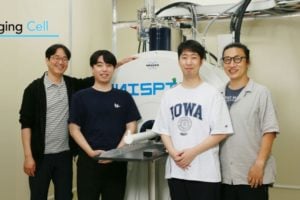
From the left, Professor Taejoon Kwon, Hwapyeong Cho, Kujin Kwon, and Professor Hyung Joon Cho in the Department of Biomedical Engineering at UNIST, took group photo with the background of MRI equipment used in the study.

How aging neurons respond to iron accumulation

Substack subscription form sign up

Comments

  • Kidreadytobreed on Global warming reduces available wind energy
  • James on Global warming reduces available wind energy
  • James on Global warming reduces available wind energy
  • Booklet AI on Key to online education: Test early and often
  • Karoly Mirnics on Common Prescription Drugs May Disrupt Cholesterol Pathways in the Womb and Raise Autism Risk
© 2026 ScienceBlog.com | Follow our RSS / XML feed