Skip to content
ScienceBlog.com
  • Featured Blogs
    • EU Horizon Blog
    • ESA Tracker
    • Experimental Frontiers
    • Josh Mitteldorf’s Aging Matters
    • Dr. Lu Zhang’s Gondwanaland
    • NeuroEdge
    • NIAAA
    • SciChi
    • The Poetry of Science
    • Wild Science
  • Topics
    • Brain & Behavior
    • Earth, Energy & Environment
    • Health
    • Life & Non-humans
    • Physics & Mathematics
    • Social Sciences
    • Space
    • Technology
  • Our Substack
  • Follow Us!
    • Bluesky
    • Threads
    • FaceBook
    • Google News
    • Twitter/X
  • Contribute/Contact

General Relativity

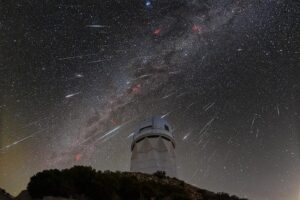
DESI observes the sky from the Mayall Telescope, shown here during the 2023 Geminid meteor shower.

DESI’s Galactic Survey Confirms Einstein’s Theory of Gravity at Cosmic Scales

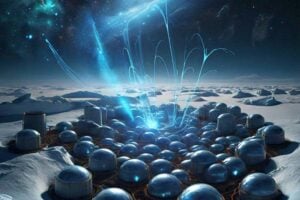
An artistic rendering of ultra-high energy neutrinos passing through the Earth, with the IceCube Observatory sensors deep in the Antarctic glacier at the south pole.

Quantum Gravity Remains Elusive as Ultra-High Energy Neutrinos Show No Signs of Spacetime Fluctuations

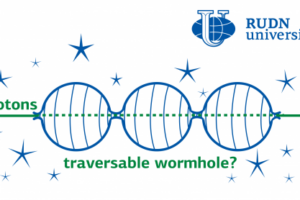
Wormhole illustration

Astrophysicists say they’ve proven passable wormholes possible

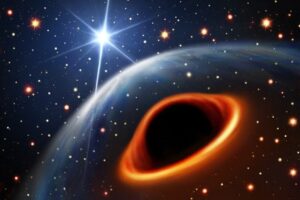
An artist’s impression of the system assuming that the massive companion star is a black hole. The brightest background star is its orbital companion, the radio pulsar PSR J0514-4002E. The two stars are separated by 8 million km and orbit each other every 7 days.

Astronomers Discover Most Massive Neutron Star—or Least Massive Black Hole

An adjustment to Newton’s gravity?

Despite doubts from quantum physicists: Einstein's theory of relativity reaffirmed

Despite doubts from quantum physicists, Einstein’s theory of relativity reaffirmed

Einstein illustration

Testing Universe’s Mysteries: Are Einstein and Euler’s Equations Up to the Task?

Cosmic April Fool

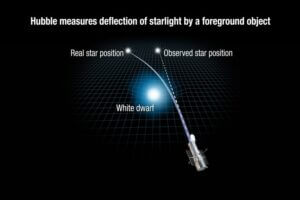
This artist's illustration shows how the gravity of a foreground white dwarf star warps space and bends the light of a distant star behind it. Astronomers using NASA's Hubble Space Telescope have for the first time directly measured the mass of a single, isolated white dwarf (the surviving core of a burned-out Sun-like star) – due to this optical trick of nature. The greater the temporary, infinitesimal deflection of the background star's image, the more massive the foreground star is. (This deviation is so small that it is equivalent to observing an ant crawl across the surface of a quarter from 1,500 miles away.) Researchers found that the dwarf is 56 percent the mass of our Sun. This effect, called gravitational lensing was predicted as a consequence of Einstein's theory of general relativity from a century ago. Observations of a solar eclipse in 1919 provided the first experimental proof for general relativity. But Einstein didn't think the same experiment could be done for stars beyond our Sun because of the extraordinary precision required.

For the first time Hubble directly measures mass of a lone white dwarf

Is the Universe Symmetric?

Substack subscription form sign up

Comments

  • Brunette Keller on How New Herpes Drugs Jam a Virus’s Replication Engine
  • Aizen on Laziness helped lead to extinction of Homo erectus
  • Norwood johnson on Electrons in New Crystals Behave as If They Live in Four Dimensions
  • ScienceBlog.com on Hidden Geometry Could Finally Fix Quantum Computers
  • Theo Prinse on America Is Going Back to the Moon. This Time, It Plans to Stay
© 2026 ScienceBlog.com | Follow our RSS / XML feed