Skip to content
ScienceBlog.com
  • Featured Blogs
    • EU Horizon Blog
    • ESA Tracker
    • Experimental Frontiers
    • Josh Mitteldorf’s Aging Matters
    • Dr. Lu Zhang’s Gondwanaland
    • NeuroEdge
    • NIAAA
    • SciChi
    • The Poetry of Science
    • Wild Science
  • Topics
    • Brain & Behavior
    • Earth, Energy & Environment
    • Health
    • Life & Non-humans
    • Physics & Mathematics
    • Social Sciences
    • Space
    • Technology
  • Our Substack
  • Follow Us!
    • Bluesky
    • Threads
    • FaceBook
    • Google News
    • Twitter/X
  • Contribute/Contact

Gravitational Lensing

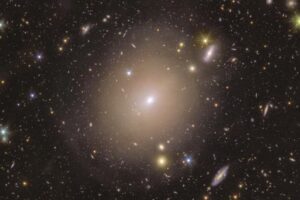
This wide field shows the extended stellar halo of NGC 6505 and showcases the Einstein ring, surrounded by colourful foreground stars and background galaxies.

Europe’s New Space Telescope Finds Perfect ‘Ring of Light’ Predicted by Einstein

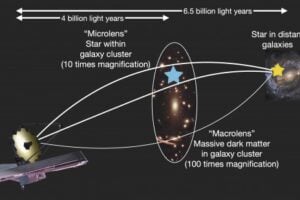
The massive, yet invisible halo of dark matter of a galaxy cluster works as a "macrolens,", while lone, unbound stars drifting through the cluster act as additional "microlenses, multiplying the factor of magnification.

Webb Telescope Discovers Over 40 Ancient Stars in Distant “Dragon Arc” Galaxy

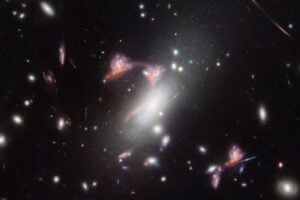
The galaxy cluster MACS-J0417.5-1154 is so massive that it bends the fabric of space-time. This causes the appearance of galaxies behind it to be distorted, an effect known as gravitational lensing. This natural phenomenon magnifies distant galaxies and can also make them appear in an image multiple times, as NASA's James Webb Space Telescope has observed. In this image, two distant, interacting galaxies - a face-on spiral and a dusty red galaxy seen from the side - appear multiple times, tracing a familiar shape across the sky. The fact that these galaxies are actively forming stars and that the face-on galaxy's spiral shape is remarkably intact indicates that their interaction is just beginning.

Webb Telescope Unveils Rare Cosmic ‘Question Mark’ in Distant Galaxy

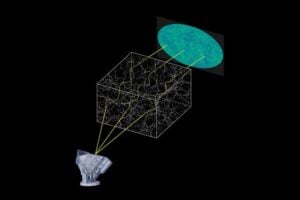
The cosmic microwave background — the universe’s oldest light — has traversed vast distances before reaching us. During its extended journey, gravitational forces from massive cosmic structures caused its trajectory to bend before being captured by the South Pole Telescope.

Results from South Pole Telescope’s new camera emerge

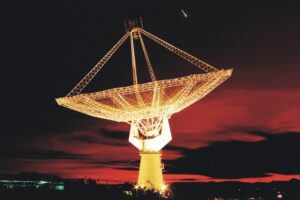
Astronomers capture radio signal from distant galaxy

Substack subscription form sign up

Comments

  • Norwood johnson on Electrons in New Crystals Behave as If They Live in Four Dimensions
  • ScienceBlog.com on Hidden Geometry Could Finally Fix Quantum Computers
  • Theo Prinse on America Is Going Back to the Moon. This Time, It Plans to Stay
  • george w on Hidden Geometry Could Finally Fix Quantum Computers
  • Tom Hughes on Years of Exercise, Blood Pressure Drugs Failed to Slow Cognitive Decline in Seniors at Dementia Risk
© 2026 ScienceBlog.com | Follow our RSS / XML feed