Skip to content
ScienceBlog.com
  • Featured Blogs
    • EU Horizon Blog
    • ESA Tracker
    • Experimental Frontiers
    • Josh Mitteldorf’s Aging Matters
    • Dr. Lu Zhang’s Gondwanaland
    • NeuroEdge
    • NIAAA
    • SciChi
    • The Poetry of Science
    • Wild Science
  • Topics
    • Brain & Behavior
    • Earth, Energy & Environment
    • Health
    • Life & Non-humans
    • Physics & Mathematics
    • Social Sciences
    • Space
    • Technology
  • Our Substack
  • Follow Us!
    • Bluesky
    • Threads
    • FaceBook
    • Google News
    • Twitter/X
  • Contribute/Contact

health risks

woman sleeping

AI Watches You Sleep: New Model Analyzes Over 1 Million Hours of Slumber

One-fourth of adults 65 and older report social isolation and one-third of adults 45 or older report being lonely. Image by www.istockphoto.com/Ruslan Lytvyn

How Loneliness and Social Isolation Impact Physical Health

Heart tissues within one of the launch-ready chambers.

Space Weakens Heart Muscle Cells, Johns Hopkins Study Reveals

Vector art of two women sitting in a couch smiling

Cannabis Use Among Older Adults: New Study Reveals Surprising Trends and Risks

Young pregnant black woman suffering from headache or migraine, feeling sick, sitting on sofa at home, free space. Sad african american expecting lady touching her forehead and big tummy, home alone

The dark side of egg donation: racial discrimination in fees and unspoken health risks

Car interior with plastic seats

New Car Smell Turns Toxic in Summer Heat

Teenage girl

Genetic Study Reveals Complex Links Between Weight Gain and Early Puberty in Girls

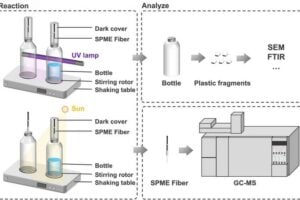
Experimental System Diagram Two sets of pre-treatments were performed in this study. The goal of the first set was to examine the generation of volatile organic compounds (VOCs) from the containers when they were exposed to irradiation without any solution inside. The aim of the second set was to analyze the VOCs generated from the containers under irradiation when they were filled halfway with different solution matrices. The irradiation experiments were carried out under conditions simulating the exposure of bottled water to sunlight. Two different types of irradiation were used: the first group underwent solar treatment, while the second group was subjected to UV-A treatment. The VOCs produced during these treatments were analyzed using Solid Phase Microextraction (SPME) and Gas Chromatography-Mass Spectrometry (GC-MS).

Sunlight Exposure Turns Plastic Water Bottles into Health Hazards, Study Reveals

processed foods

Consistent evidence links ultra-processed food to over 30 damaging health outcomes

A close-up image of tattoo ink bottles with misleading labels juxtaposed against laboratory equipment, symbolizing the research's investigative nature

Tattoo inks don’t match the ingredients listed on the bottle

Trucks on a highway

Breathing highway air increases blood pressure

Image: José-Luis Olivares, MIT; iStock

Germicidal UV lights could be producing indoor air pollutants, study finds

Fig 5. Circosplots of co-medication pairs with ORs >1 with known (left) or unknown (right) DDIs. Relations between an index drug and its co-medication are marked by connecting bands, with the width of each band proportional to the number of pairs found between two therapeutic groups (the thinnest ribbon represents one pair, e.g. C07-P01 in the set of known DDIs and A10-N04 in the set of unknown DDIs). The outer ring corresponds to the anatomical main groups, and the inner ring corresponds to the therapeutic groups. Colour of connecting bands corresponds to the anatomical group of the co-medication. See colour legend in Fig 1. The most abundant known DDI relations were observed between N05-N06, N05-N05 and B01-J01. Unknown DDIs mostly involved the therapeutic groups J01 (e.g. J01-A10), B05 (e.g. B05-N02), A12 (e.g. A12-R03), A10 (e.g. B01-A10), R03 (e.g. J01-R03) and M05 (e.g. B01-M05). DDI: drug-drug interaction. OR: odds ratio.

Dosage tweaks may hint at undiscovered interactions between medications

Tampon. Pixabay

Indicator of PFAS found in some — but not all — period products

Older posts
Page1 Page2 Next →
Substack subscription form sign up

Comments

  • Kidreadytobreed on Global warming reduces available wind energy
  • James on Global warming reduces available wind energy
  • James on Global warming reduces available wind energy
  • Booklet AI on Key to online education: Test early and often
  • Karoly Mirnics on Common Prescription Drugs May Disrupt Cholesterol Pathways in the Womb and Raise Autism Risk
© 2026 ScienceBlog.com | Follow our RSS / XML feed