Skip to content
ScienceBlog.com
  • Featured Blogs
    • EU Horizon Blog
    • ESA Tracker
    • Experimental Frontiers
    • Josh Mitteldorf’s Aging Matters
    • Dr. Lu Zhang’s Gondwanaland
    • NeuroEdge
    • NIAAA
    • SciChi
    • The Poetry of Science
    • Wild Science
  • Topics
    • Brain & Behavior
    • Earth, Energy & Environment
    • Health
    • Life & Non-humans
    • Physics & Mathematics
    • Social Sciences
    • Space
    • Technology
  • Our Substack
  • Follow Us!
    • Bluesky
    • Threads
    • FaceBook
    • Google News
    • Twitter/X
  • Contribute/Contact

Heavy elements

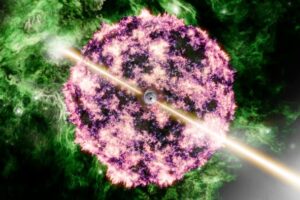
Artist's visualization of GRB 221009A showing the narrow relativistic jets — emerging from a central black hole — that gave rise to the GRB and the expanding remains of the original star ejected via the supernova explosion. Using the James Webb Space Telescope, Northwestern University postdoctoral fellow Peter Blanchard and his team detected the supernova for the first time, confirming GRB 221009A was the result of the collapse of a massive star. The study’s co-authors also found that the event occurred in a dense star forming region of its host galaxy as depicted by the background nebula.

Unraveling the Mysteries of the Brightest Gamma-Ray Burst: A Supernova Without Heavy Elements

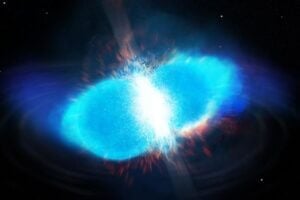
Neutron Star Merger

First hints of nuclear fission in cosmos revealed by models, observations

Substack subscription form sign up

Comments

  • Brunette Keller on How New Herpes Drugs Jam a Virus’s Replication Engine
  • Aizen on Laziness helped lead to extinction of Homo erectus
  • Norwood johnson on Electrons in New Crystals Behave as If They Live in Four Dimensions
  • ScienceBlog.com on Hidden Geometry Could Finally Fix Quantum Computers
  • Theo Prinse on America Is Going Back to the Moon. This Time, It Plans to Stay
© 2026 ScienceBlog.com | Follow our RSS / XML feed