Skip to content
ScienceBlog.com
  • Featured Blogs
    • EU Horizon Blog
    • ESA Tracker
    • Experimental Frontiers
    • Josh Mitteldorf’s Aging Matters
    • Dr. Lu Zhang’s Gondwanaland
    • NeuroEdge
    • NIAAA
    • SciChi
    • The Poetry of Science
    • Wild Science
  • Topics
    • Brain & Behavior
    • Earth, Energy & Environment
    • Health
    • Life & Non-humans
    • Physics & Mathematics
    • Social Sciences
    • Space
    • Technology
  • Our Substack
  • Follow Us!
    • Bluesky
    • Threads
    • FaceBook
    • Google News
    • Twitter/X
  • Contribute/Contact

Herbig

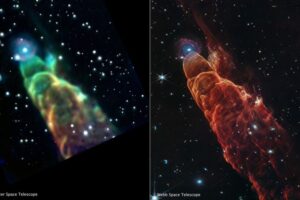
This side-by-side comparison shows a Spitzer Space Telescope Infrared Array Camera image of HH 49/50 (left) versus a Webb image of the same object (right) using the NIRCam (Near-infrared Camera) instrument and MIRI (Mid-infrared Instrument). The Webb image shows intricate details of the heated gas and dust as the protostellar jet slams into the material. Webb also resolves the “fuzzy” object located at the tip of the outflow into a distant spiral galaxy. The Spitzer image shows 3.6-micron light in blue, the 4.5-micron in green, and the 8.0-micron in red (IRAC1, IRAC2, IRAC4). In the Webb image, blue represents light at 2.0-microns (F200W), cyan represents light at 3.3-microns (F335M), green is 4.4-microns (F444W), orange is 4.7-microns (F470N), and red is 7.7-microns (F770W).

NASA’s Webb Telescope Unmasks True Nature of the Cosmic Tornado

Substack subscription form sign up

Comments

  • Karoly Mirnics on Common Prescription Drugs May Disrupt Cholesterol Pathways in the Womb and Raise Autism Risk
  • Aizen on Laziness helped lead to extinction of Homo erectus
  • Norwood johnson on Electrons in New Crystals Behave as If They Live in Four Dimensions
  • ScienceBlog.com on Hidden Geometry Could Finally Fix Quantum Computers
  • Theo Prinse on America Is Going Back to the Moon. This Time, It Plans to Stay
© 2026 ScienceBlog.com | Follow our RSS / XML feed