Skip to content
ScienceBlog.com
  • Featured Blogs
    • EU Horizon Blog
    • ESA Tracker
    • Experimental Frontiers
    • Josh Mitteldorf’s Aging Matters
    • Dr. Lu Zhang’s Gondwanaland
    • NeuroEdge
    • NIAAA
    • SciChi
    • The Poetry of Science
    • Wild Science
  • Topics
    • Brain & Behavior
    • Earth, Energy & Environment
    • Health
    • Life & Non-humans
    • Physics & Mathematics
    • Social Sciences
    • Space
    • Technology
  • Our Substack
  • Follow Us!
    • Bluesky
    • Threads
    • FaceBook
    • Google News
    • Twitter/X
  • Contribute/Contact

HIV

Person getting vaccinated

Revolutionary HIV Prevention: Twice-Yearly Injection Shows Near-Perfect Protection in Landmark Trial

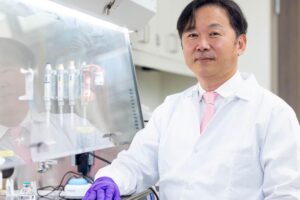
Lead study author Woong-Ki Kim, PhD, associate director for research at Tulane National Primate Research Center. Photo by Sabree Hill.

Promising New Drug Could Clear HIV from the Brain, Tulane Study Reveals

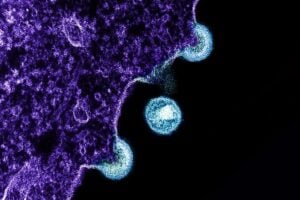
Transmission electron micrograph of HIV-1 virus particles (blue) from infected H9 cells, produced in cell culture. The particles exhibit two stages of replication: the two “arcs” are immature particles budding from the plasma membrane of the cell, and the center spherical particle is a mature form in extracellular space. Image captured at the NIAID Integrated Research Facility in Fort Detrick, Maryland.

NIH-developed HIV antibodies protect animals in proof-of-concept study

HIV virus

People on ART with low but detectible levels of virus have almost zero risk of sexually transmitting the virus to others


HIV virus closeup

HIV can persist for years in myeloid cells of people on antiretroviral therapy

Substack subscription form sign up

Comments

  • Brunette Keller on How New Herpes Drugs Jam a Virus’s Replication Engine
  • Aizen on Laziness helped lead to extinction of Homo erectus
  • Norwood johnson on Electrons in New Crystals Behave as If They Live in Four Dimensions
  • ScienceBlog.com on Hidden Geometry Could Finally Fix Quantum Computers
  • Theo Prinse on America Is Going Back to the Moon. This Time, It Plans to Stay
© 2026 ScienceBlog.com | Follow our RSS / XML feed