Skip to content
ScienceBlog.com
  • Featured Blogs
    • EU Horizon Blog
    • ESA Tracker
    • Experimental Frontiers
    • Josh Mitteldorf’s Aging Matters
    • Dr. Lu Zhang’s Gondwanaland
    • NeuroEdge
    • NIAAA
    • SciChi
    • The Poetry of Science
    • Wild Science
  • Topics
    • Brain & Behavior
    • Earth, Energy & Environment
    • Health
    • Life & Non-humans
    • Physics & Mathematics
    • Social Sciences
    • Space
    • Technology
  • Our Substack
  • Follow Us!
    • Bluesky
    • Threads
    • FaceBook
    • Google News
    • Twitter/X
  • Contribute/Contact

Host

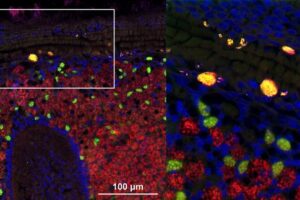
Fluorescence in situ hybridization (FISH) confocal microscopy image of deep-sea mussel tissue. The intranuclear parasite Ca. Endonucleobacter is shown in yellow, while beneficial symbiotic bacteria are labeled in green and red. Cell nuclei are stained blue. The right panel zooms in on the white square highlighted in the left panel.

Nuclear Hijackers: Deep-Sea Mussels’ Bacteria Reveal Surprising Survival Tactics

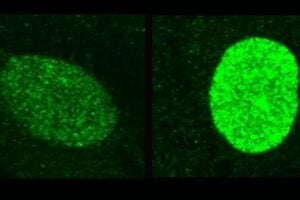
These microscope images show how interferon in the nucleus raises levels of the protective protein IFI16 (stained green) from low background levels (left) to the higher levels needed to resist herpes infection (right). Image: HMS MicRoN core imaging facility/Nicolas Romero Rata

How the Immune System Fights to Keep Herpes at Bay

A researcher holds open a preserved fish specimen that has been inspected for parasites. The study included eight fish species and 699 fish specimens, which yielded more than 17,000 parasites.

Warming oceans have decimated marine parasites — but that’s not a good thing

Substack subscription form sign up

Comments

  • Mark Mellinger on Living Plastic Can Self-Destruct on Command
  • Marie Feret on The Silent Frequency That Makes Old Buildings Feel Haunted
  • Dax on The Silent Frequency That Makes Old Buildings Feel Haunted
  • Karoly Mirnics on Common Prescription Drugs May Disrupt Cholesterol Pathways in the Womb and Raise Autism Risk
  • Aizen on Laziness helped lead to extinction of Homo erectus
© 2026 ScienceBlog.com | Follow our RSS / XML feed