Skip to content
ScienceBlog.com
  • Featured Blogs
    • EU Horizon Blog
    • ESA Tracker
    • Experimental Frontiers
    • Josh Mitteldorf’s Aging Matters
    • Dr. Lu Zhang’s Gondwanaland
    • NeuroEdge
    • NIAAA
    • SciChi
    • The Poetry of Science
    • Wild Science
  • Topics
    • Brain & Behavior
    • Earth, Energy & Environment
    • Health
    • Life & Non-humans
    • Physics & Mathematics
    • Social Sciences
    • Space
    • Technology
  • Our Substack
  • Follow Us!
    • Bluesky
    • Threads
    • FaceBook
    • Google News
    • Twitter/X
  • Contribute/Contact

Hot Jupiter

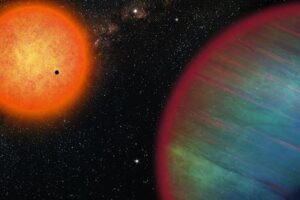
The WASP-132 system contains a Hot Jupiter (in the foreground), an inner super-Earth (here transiting in front of the orange host star) and the planet WASP-132d, discovered towards the outside of the system.

Hot Jupiters Don’t Always Destroy Their Neighbors

This phase curve, captured by the MIRI low resolution spectrometer on NASA’s James Webb Space Telescope, shows the change in brightness of the WASP-43 system over time as the planet orbits its star. The system appears brightest when the hot dayside of the planet is facing the telescope, just before and after it passes behind the star. The system grows dimmer as the planet continues its orbits and the nightside rotates into view. It brightens again after passing in front of the star as the dayside rotates back into view. WASP-43 b is a hot Jupiter roughly 280 light-years away, in the constellation Sextans.

Webb Telescope Unveils Extreme Weather on Distant Exoplanet WASP-43 b

Substack subscription form sign up

Comments

  • Monte Dale Jr on Cracks Are Appearing in the Geometric Assumption Underlying All of Modern Cosmology
  • Not Buying Yer Bullshit on More Than a Third of Americans Have Lost Relationships Over Politics
  • Marco Messina on More Than a Third of Americans Have Lost Relationships Over Politics
  • Anon on Why Fructose Behaves Less Like a Calorie and More Like a Hormone
  • Mark Mellinger on Living Plastic Can Self-Destruct on Command
© 2026 ScienceBlog.com | Follow our RSS / XML feed