Skip to content
ScienceBlog.com
  • Featured Blogs
    • EU Horizon Blog
    • ESA Tracker
    • Experimental Frontiers
    • Josh Mitteldorf’s Aging Matters
    • Dr. Lu Zhang’s Gondwanaland
    • NeuroEdge
    • NIAAA
    • SciChi
    • The Poetry of Science
    • Wild Science
  • Topics
    • Brain & Behavior
    • Earth, Energy & Environment
    • Health
    • Life & Non-humans
    • Physics & Mathematics
    • Social Sciences
    • Space
    • Technology
  • Our Substack
  • Follow Us!
    • Bluesky
    • Threads
    • FaceBook
    • Google News
    • Twitter/X
  • Contribute/Contact

Human Evolution

a man seen in profile, speaking, with an illustration of the sound waves coming directly out of his mouth

The Dawn of Words: Did Language Emerge 135,000 Years Ago?

a man seen in profile, speaking, with an illustration of the sound waves coming directly out of his mouth

Single Amino Acid Mutation May Have Helped Shape Human Language Ability

Life appearance reconstruction of a Neanderthal male at the Natural History Museum of London.

How Neanderthals Nearly Vanished 110,000 Years Ago

Expression pattern of NOVA1 in the brain of amouse. NOVA1 in green, nuclei (DAPI) in blue.

A single protein may have helped shape the emergence of spoken language

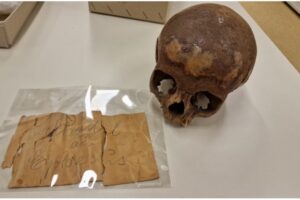
Fig. 1: The cranium from the Ephesos Octagon in the Collection of the Department of Evolutionary Anthropology, University of Vienna. The yellowed note coming with it says: “Skull from Ephesus”.

Mystery of Cleopatra’s Sister: Ancient Skull Reveals Surprising Identity

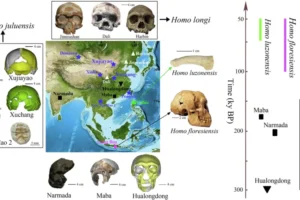
This caption explains the classification and grouping of hominin fossils: Homo juluensis (blue stars): Xujiayao, Xuchang, Xiahe, Penghu, Denisova, and Tam Ngu Hao 2. Homo longi (white triangles): Harbin, Dali, and Jinniushan. Homo floresiensis (pink diamond): Liang Bua. Homo luzonensis (green circle): Callao. Hualongdong (black inverted triangle), previously grouped with H. longi, is treated separately pending further investigation. Maba and Narmada (black squares), often considered a distinct population, may eventually be classified as H. neanderthalensis or given a new taxonomic name after further analysis. Details on type specimens and sites for the four species—H. floresiensis, H. luzonensis, H. longi, and H. juluensis—are provided in the accompanying box.

Scientists Find New Human Species in Asia, Reshaping Our Family Tree

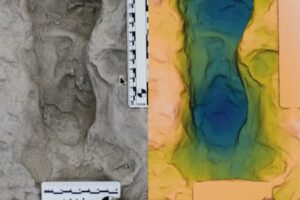
Overhead image (left) and height map (right) of 3D model of track H3. Scale bars are 15 cm and 8 cm. Height map spans 8 cm from deepest blue to white.

Ancient Footprints Reveal Two Human Species Sharing Lake Shores 1.5 Million Years Ago

Artist's impression of Denisovan family near cave opening

Neanderthal DNA Reveals Clues to Their Extinction

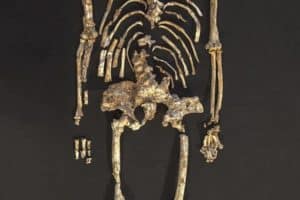
Primate fossil

Hidden Bias in Human Evolution: How Fossil Hotspots Skew Our Understanding of Our Origins

Artist's impression of Denisovan family near cave opening

Ancient Human Species Thrived on Tibetan Plateau for 160,000 Years

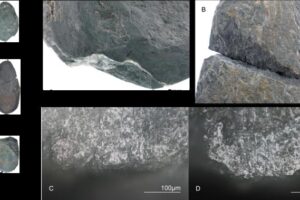
Characteristic macroscopic (top) and microscopic (bottom) traces might be used to determine how stone edges were used.

Scientists try out stone age tools to understand how they were used

Yamnaya Bronze relief

Ancient DNA reveals reason for high MS and Alzheimer’s rates in Europe

A Neanderthals having coffee early in the morning

Were Neanderthals morning people ?

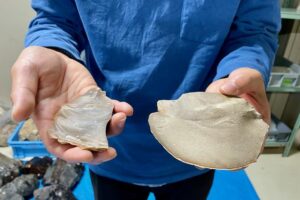
An archaeologist, Eiki Suga, showing fine-grained flint (left) and middle-grained flint (right).

Paleolithic humans may have understood the properties of rocks for making stone tools

Older posts
Page1 Page2 Next →
Substack subscription form sign up

Comments

  • Karoly Mirnics on Common Prescription Drugs May Disrupt Cholesterol Pathways in the Womb and Raise Autism Risk
  • Aizen on Laziness helped lead to extinction of Homo erectus
  • Norwood johnson on Electrons in New Crystals Behave as If They Live in Four Dimensions
  • ScienceBlog.com on Hidden Geometry Could Finally Fix Quantum Computers
  • Theo Prinse on America Is Going Back to the Moon. This Time, It Plans to Stay
© 2026 ScienceBlog.com | Follow our RSS / XML feed