Skip to content
ScienceBlog.com
  • Featured Blogs
    • EU Horizon Blog
    • ESA Tracker
    • Experimental Frontiers
    • Josh Mitteldorf’s Aging Matters
    • Dr. Lu Zhang’s Gondwanaland
    • NeuroEdge
    • NIAAA
    • SciChi
    • The Poetry of Science
    • Wild Science
  • Topics
    • Brain & Behavior
    • Earth, Energy & Environment
    • Health
    • Life & Non-humans
    • Physics & Mathematics
    • Social Sciences
    • Space
    • Technology
  • Our Substack
  • Follow Us!
    • Bluesky
    • Threads
    • FaceBook
    • Google News
    • Twitter/X
  • Contribute/Contact

Hypervelocity stars

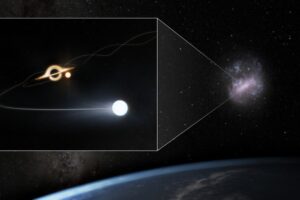
Artist’s impression of a hypervelocity star ejected from the Large Magellanic Cloud (shown on right). When a binary star system ventures too close to a supermassive black hole, the intense gravitational forces tear the pair apart. One star is captured into a tight orbit around the black hole, while the other is flung outward at extreme velocities—often exceeding thousands of kilometers per second—becoming a hypervelocity star. The inset illustration depicts this process: the original binary’s orbital path is shown as interwoven lines, with one star being captured by the black hole (near center of inset) while the other is ejected into space (lower right).

Runaway Stars Reveal Hidden Black Hole in Milky Way’s Nearest Neighbor

Substack subscription form sign up

Comments

  • Monte Dale Jr on Cracks Are Appearing in the Geometric Assumption Underlying All of Modern Cosmology
  • Yehuda on A Pill That Keeps Your Throat Awake Could Transform Sleep Apnea Treatment
  • Jeffrey Erle Cunha on Cracks Are Appearing in the Geometric Assumption Underlying All of Modern Cosmology
  • Monte Dale Jr on Cracks Are Appearing in the Geometric Assumption Underlying All of Modern Cosmology
  • Monte Dale Jr on Cracks Are Appearing in the Geometric Assumption Underlying All of Modern Cosmology
© 2026 ScienceBlog.com | Follow our RSS / XML feed