Skip to content
ScienceBlog.com
  • Featured Blogs
    • EU Horizon Blog
    • ESA Tracker
    • Experimental Frontiers
    • Josh Mitteldorf’s Aging Matters
    • Dr. Lu Zhang’s Gondwanaland
    • NeuroEdge
    • NIAAA
    • SciChi
    • The Poetry of Science
    • Wild Science
  • Topics
    • Brain & Behavior
    • Earth, Energy & Environment
    • Health
    • Life & Non-humans
    • Physics & Mathematics
    • Social Sciences
    • Space
    • Technology
  • Our Substack
  • Follow Us!
    • Bluesky
    • Threads
    • FaceBook
    • Google News
    • Twitter/X
  • Contribute/Contact

Ice Age

Recently excavated mastodon tooth, still embedded in the jaw

Ice Age Giant Emerges from New York Backyard

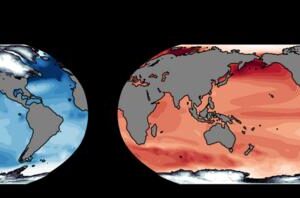
The left panel illustrates sea surface temperature variations between the most recent ice age, approximately 21,000 years ago, and modern preindustrial temperatures. This refined analysis highlights significant cooling over the northern oceans, attributed to the presence of the North American ice sheet, which significantly contributed to the overall global cooling trend. In contrast, the right panel depicts anticipated changes in ocean surface temperatures under a scenario of doubled atmospheric CO2 concentrations in the future. This projection reveals a distinct pattern of temperature change, suggesting lower globally averaged warming than previously anticipated in worst-case scenarios.

New Study Reduces Absolute Worst-Case Warming Scenario

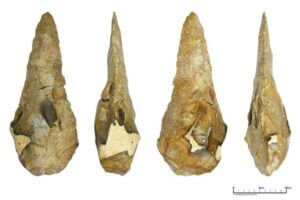
The largest giant handaxe

Giant stone artifacts found on rare Ice Age site in Kent

Substack subscription form sign up

Comments

  • Monte Dale Jr on Cracks Are Appearing in the Geometric Assumption Underlying All of Modern Cosmology
  • Monte Dale Jr on Cracks Are Appearing in the Geometric Assumption Underlying All of Modern Cosmology
  • Not Buying Yer Bullshit on More Than a Third of Americans Have Lost Relationships Over Politics
  • Marco Messina on More Than a Third of Americans Have Lost Relationships Over Politics
  • Anon on Why Fructose Behaves Less Like a Calorie and More Like a Hormone
© 2026 ScienceBlog.com | Follow our RSS / XML feed