Skip to content
ScienceBlog.com
  • Featured Blogs
    • EU Horizon Blog
    • ESA Tracker
    • Experimental Frontiers
    • Josh Mitteldorf’s Aging Matters
    • Dr. Lu Zhang’s Gondwanaland
    • NeuroEdge
    • NIAAA
    • SciChi
    • The Poetry of Science
    • Wild Science
  • Topics
    • Brain & Behavior
    • Earth, Energy & Environment
    • Health
    • Life & Non-humans
    • Physics & Mathematics
    • Social Sciences
    • Space
    • Technology
  • Our Substack
  • Follow Us!
    • Bluesky
    • Threads
    • FaceBook
    • Google News
    • Twitter/X
  • Contribute/Contact

Infrared astronomy

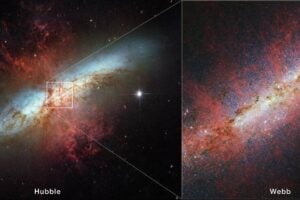
On the left is the starburst galaxy M82 as observed by NASA’s Hubble Space Telescope in 2006. The small box at the galaxy’s core corresponds to the area captured so far by the NIRCam (Near-Infrared Camera) instrument on NASA’s James Webb Space Telescope. The red filaments as seen by Webb are the polycyclic aromatic hydrocarbon emission, which traces the shape of the galactic wind. In the Hubble image, light at .814 microns is colored red, .658 microns is red-orange, .555 microns is green, and .435 microns is blue (filters F814W, F658N, F555W, and F435W, respectively). In the Webb image, light at 3.35 microns is colored red, 2.50 microns is green, and 1.64 microns is blue (filters F335M, F250M, and F164N, respectively). NASA, ESA, CSA, STScI, A. Bolatto (University of Maryland)

NASA’s James Webb Space Telescope Uncovers Secrets of Starburst Galaxy

Many chemical elements are formed during a supernova explosion, so studying them can give scientists insight into the universe's chemical make-up.

Galactic explosion offers astrophysicists new insight into the cosmos

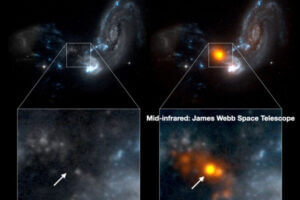
Astronomers from an international team have used the James Webb Space Telescope to reveal, for the first time, the exact location of the source powering colliding galaxies. Curiously, this source lies outside of the main parts of the galaxies and is not visible at all in the ultraviolet or visible light observed with the Hubble Space Telescope.

‘Engine’ of luminous merging galaxies pinpointed for the first time

Substack subscription form sign up

Comments

  • Norwood johnson on Electrons in New Crystals Behave as If They Live in Four Dimensions
  • ScienceBlog.com on Hidden Geometry Could Finally Fix Quantum Computers
  • Theo Prinse on America Is Going Back to the Moon. This Time, It Plans to Stay
  • george w on Hidden Geometry Could Finally Fix Quantum Computers
  • Tom Hughes on Years of Exercise, Blood Pressure Drugs Failed to Slow Cognitive Decline in Seniors at Dementia Risk
© 2026 ScienceBlog.com | Follow our RSS / XML feed