Skip to content
ScienceBlog.com
  • Featured Blogs
    • EU Horizon Blog
    • ESA Tracker
    • Experimental Frontiers
    • Josh Mitteldorf’s Aging Matters
    • Dr. Lu Zhang’s Gondwanaland
    • NeuroEdge
    • NIAAA
    • SciChi
    • The Poetry of Science
    • Wild Science
  • Topics
    • Brain & Behavior
    • Earth, Energy & Environment
    • Health
    • Life & Non-humans
    • Physics & Mathematics
    • Social Sciences
    • Space
    • Technology
  • Our Substack
  • Follow Us!
    • Bluesky
    • Threads
    • FaceBook
    • Google News
    • Twitter/X
  • Contribute/Contact

learning

human brain illustration

Scientists ‘Write’ New Learning Patterns Directly into the Human Brain

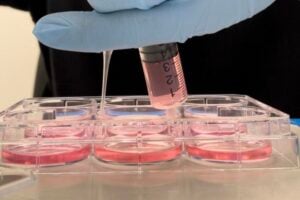
An NYU researcher administers chemical signals to non-neural cells grown in a culture plate.

Your Body Has Hidden Memories: Scientists Discover Cells Outside the Brain Can Learn

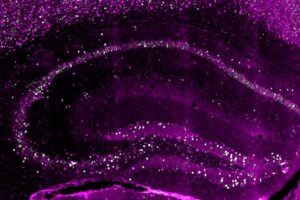
Early-born neurons (magenta) in the hippocampus create a long-persisting copy of a memory.

Brain Creates Triple Backup: New Study Reveals Multiple Copies of Memories

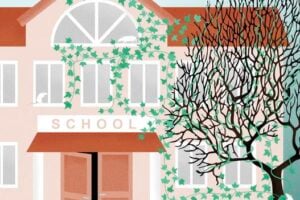
Climbing fibres, in the form of ivy, wrap around the branches of a Purkinje cell-shaped tree, within the vibrant courtyard of a school populated by mice. The illustration captures the essential role of climbing fibres as teaching signals for associative cerebellar learning.

“Zombie neurons” shed light on how the brain learns

Student memorizing information from a textbook

Study: Best way to memorize stuff? It depends…

Students undergo EEG while hand- and typewriting.

Writing by hand may increase brain connectivity more than typing on a keyboard

Zebra finch

When needs compete, love trumps thirst

Math work on a piece of paper

Exciting the brain could be key to boosting maths learning

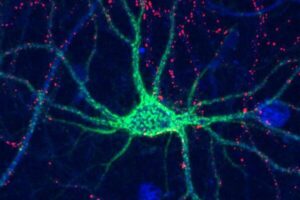
Complex sugar molecules control the formation of perineuronal nets (shown here in green) that surround neurons to help stabilize connections in the brain.

Sugars affect brain ‘plasticity,’ helping with learning, memory, recovery

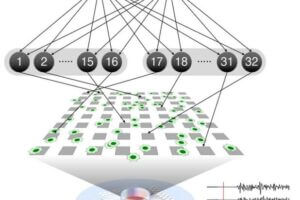
The experimental setup. Cultured neurons grew on top of electrodes. Patterns of electrical stimulation trained the neurons to reorganize so that they could distinguish two hidden sources. Waveforms at the bottom represent the spiking responses to a sensory stimulus (red line).

Math theory predicts self-organized learning in real neurons

Child's hand moving a piece on the board of Monopoly. Credit Pixabay

Number-Based Board Games Improve Math Skills in Young Children

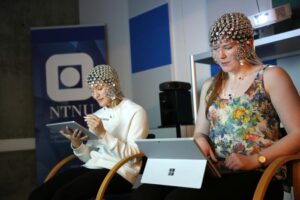
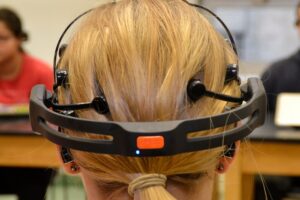
The researchers used portable electroencephalogram (EEG) technology (pictured above) to measure the brainwaves of students and instructors.

In sync brainwaves predict learning
Substack subscription form sign up

Comments

  • Brunette Keller on How New Herpes Drugs Jam a Virus’s Replication Engine
  • Aizen on Laziness helped lead to extinction of Homo erectus
  • Norwood johnson on Electrons in New Crystals Behave as If They Live in Four Dimensions
  • ScienceBlog.com on Hidden Geometry Could Finally Fix Quantum Computers
  • Theo Prinse on America Is Going Back to the Moon. This Time, It Plans to Stay
© 2026 ScienceBlog.com | Follow our RSS / XML feed