Skip to content
Menu
Featured Blogs
EU Horizon Blog
ESA Tracker
Experimental Frontiers
Josh Mitteldorf’s Aging Matters
Dr. Lu Zhang’s Gondwanaland
NeuroEdge
NIAAA
SciChi
The Poetry of Science
Wild Science
Topics
Brain & Behavior
Earth, Energy & Environment
Health
Life & Non-humans
Physics & Mathematics
Social Sciences
Space
Technology
Our Substack
Follow Us!
Bluesky
Threads
FaceBook
Google News
Twitter/X
Contribute/Contact
Light Pollution
World’s Darkest Observatory Under Threat from Massive Industrial Development
Light Pollution Disrupts Bee Sleep Patterns, Threatening Vital Pollinators
Light Pollution Linked to Higher Alzheimer’s Risk, Especially in Younger Adults
Streetlights running all night makes leaves so tough that insects can’t eat them
Artificial light is luring birds to cities and sometimes to their deaths
Spawning Shadows
Artificial Bites at Night
Short-term bang of fireworks has long-term impact on wildlife
Stars disappear before our eyes, citizen scientists report
SpaceX Agrees to Mitigate Impact of Starlink Satellites on Astronomy

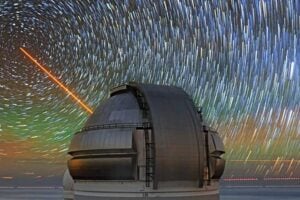
![On December 24th, AES Andes, a subsidiary of the US power company AES Corporation, submitted a project for a massive industrial complex for environmental impact assessment. This complex threatens the pristine skies above ESO’s Paranal Observatory in Chile’s Atacama Desert, the darkest and clearest of any astronomical observatory in the world [1]. The industrial megaproject is planned to be located just 5 to 11 kilometres from telescopes at Paranal, which would cause irreparable damage to astronomical observations, in particular due to light pollution emitted throughout the project’s operational life. Relocating the complex would save one of Earth's last truly pristine dark skies.](https://scienceblog.com/wp-content/uploads/2025/01/potw2124a-300x200.jpg)