Skip to content
ScienceBlog.com
  • Featured Blogs
    • EU Horizon Blog
    • ESA Tracker
    • Experimental Frontiers
    • Josh Mitteldorf’s Aging Matters
    • Dr. Lu Zhang’s Gondwanaland
    • NeuroEdge
    • NIAAA
    • SciChi
    • The Poetry of Science
    • Wild Science
  • Topics
    • Brain & Behavior
    • Earth, Energy & Environment
    • Health
    • Life & Non-humans
    • Physics & Mathematics
    • Social Sciences
    • Space
    • Technology
  • Our Substack
  • Follow Us!
    • Bluesky
    • Threads
    • FaceBook
    • Google News
    • Twitter/X
  • Contribute/Contact

material science

Nanopores are the secret to making electricity from thin air.

Engineers harvest clean energy from thin air

A Brief History of Science

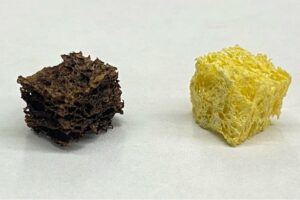
Sponge coated with nanoparticles (left) next to an uncoated cellulose sponge

Metal-filtering sponge removes lead from water

For priceless European art, extra protection costs very little

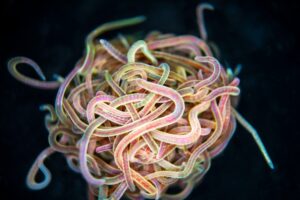
A new study explains how California blackworms can twist and curl around each other by the thousands, forming tightly wound balls and then untangling just as quickly. Credits:Image: Harry Tuazon

How to untangle a worm ball: Mathematicians solve a knotty mystery

Spiderweb with dew in the morning

Orb weaver spider glue properties evolve faster than their glue genes

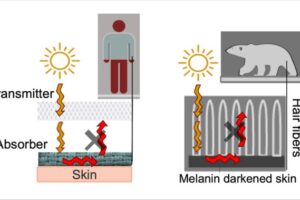
Inspired by polar bears, this new textile creates an on-body “greenhouse” effect to keep you warm.

New cloth unravels warmth-trapping secrets of polar bear fur

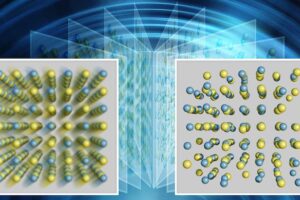
At slow shutter speeds, the atomic structure of GeTE looks ordered but blurred. Faster exposures reveal a clear intricate pattern of dynamic displacements. Credit: Jill Hemman/ORNL, U.S. Dept. of Energy

Camera with shutter speed of 1 trillionth of a second sees through dynamic disorder of atoms

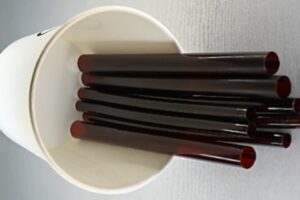
These new bioplastic straws made using potato starch and lignin are strong in water but still biodegrade.

This starchy bioplastic could make soggy paper straws a thing of the past

A large-area elemental map (Calcium: red, Silicon: blue, Aluminum: green) of a 2 cm fragment of ancient Roman concrete (right) collected from the archaeological site of Privernum, Italy (left). A calcium-rich lime clast (in red), which is responsible for the unique self-healing properties in this ancient material, is clearly visible in the lower region of the image. Credits:Courtesy of the researchers

Riddle solved: Why was Roman concrete so durable?

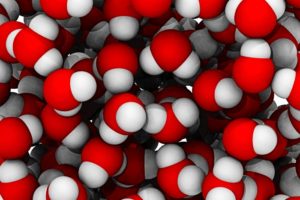
Molecular simulation results showing how water molecules move and structure around one another in the high density liquid phase.

Using machine learning to better understand how water behaves

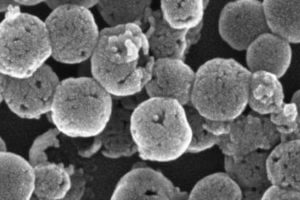
Nanoparticles in black and white

‘Raspberry-shaped’ nanoparticles look good for precision drug delivery

Newer posts
← Previous Page1 Page2
Substack subscription form sign up

Comments

  • Karoly Mirnics on Common Prescription Drugs May Disrupt Cholesterol Pathways in the Womb and Raise Autism Risk
  • Aizen on Laziness helped lead to extinction of Homo erectus
  • Norwood johnson on Electrons in New Crystals Behave as If They Live in Four Dimensions
  • ScienceBlog.com on Hidden Geometry Could Finally Fix Quantum Computers
  • Theo Prinse on America Is Going Back to the Moon. This Time, It Plans to Stay
© 2026 ScienceBlog.com | Follow our RSS / XML feed