Skip to content
ScienceBlog.com
  • Featured Blogs
    • EU Horizon Blog
    • ESA Tracker
    • Experimental Frontiers
    • Josh Mitteldorf’s Aging Matters
    • Dr. Lu Zhang’s Gondwanaland
    • NeuroEdge
    • NIAAA
    • SciChi
    • The Poetry of Science
    • Wild Science
  • Topics
    • Brain & Behavior
    • Earth, Energy & Environment
    • Health
    • Life & Non-humans
    • Physics & Mathematics
    • Social Sciences
    • Space
    • Technology
  • Our Substack
  • Follow Us!
    • Bluesky
    • Threads
    • FaceBook
    • Google News
    • Twitter/X
  • Contribute/Contact

mental health

Allison Burk takes medication to manage ADHD. She was diagnosed with the condition as an adult, resolving years of unanswered questions about issues with focus and impulsivity that affected every area of her life.

One in 4 Adults Suspect Undiagnosed ADHD, Raising Concerns About Self-Diagnosis

cheerleaders

High Rates of Psychological Abuse in Swedish Cheerleading

Artsy representation of human eye

When detecting depression, the eyes have it

Syrian refugees walking in Jordan.

Self-compassion is related to better mental health among Syrian refugees

Psilocybe mushrooms

Psilocybin Therapy Could Help Millions with Depression, Study Reveals

Researchers have formed a consortium called SSPsyGene with the shared objective of studying the genetic causes of neurodevelopmental and psychiatric disorders (NPD). Their focus is on 250 high-risk genes that may contribute to these conditions. In the project's initial phase, they tested 23 of these risk genes. The stem cell lines they generated from this research will be shared globally to aid other scientists in studying how these genes contribute to NPD.

Scientists aim to decode the genetic roots of mental illness on a large scale

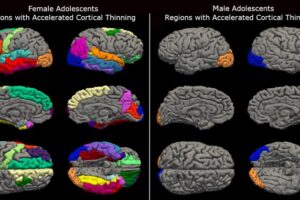
New research from the University of Washington’s Institute for Learning & Brain Sciences, or I-LABS, found the COVID-19 pandemic lockdowns resulted in unusually accelerated brain maturation in adolescents. This maturation was more pronounced in females, as seen on the left.

COVID-19 Lockdowns Sped Up Brain Aging in Teens, Especially Girls

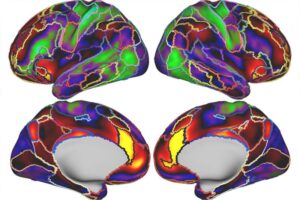
The image displays four views of a person's brain, highlighting the boundaries between different functional brain networks, each represented by different colored lines, as mapped using functional MRI. This map is overlaid on a salience network connectivity heat map, where warmer colors indicate stronger connectivity within the salience network. Researchers discovered that a larger salience network may be associated with an increased risk of depression. Credit: Lynch/Liston Labs.

Brain Scans Reveal Neuronal ‘Wiring’ Linked to Depression Risk

bored man looking at cell phone

Swiping Through Online Videos Increases Boredom

homeless man on bench

Homeless Individuals Face Constant Police Scrutiny, New Study Reveals

stressed out young girl

Childhood Neglect Linked to More Severe Cognitive Deficits Than Previously Recognized

woman in bed

Loneliness Linked to More Frequent and Intense Nightmares

Ohio State logo

In law enforcement, a link between head injuries and depression, PTSD

Woman sitting in chair watching tv

New Model Reveals Rapid Spread of Suicide Contagion After Celebrity Deaths

Older posts
Newer posts
← Previous Page1 Page2 Page3 Page4 … Page14 Next →
Substack subscription form sign up

Comments

  • Sue Ann Hayes on Hidden Nuclear Protein Fuels Pancreatic Cancer’s Deadly Aggression
  • Curtis Webber on The GPS-Killer? This Quantum Device ‘Feels’ Motion Like a Brain—Down to the Atomic Level
  • Ran on How the Age You First Had Sex Could Shape How You Age Decades Later
  • Sparty on How the Age You First Had Sex Could Shape How You Age Decades Later
  • Josh Mitteldorf on A Single TV Segment Sent Leucovorin Prescriptions for Autistic Children Soaring 2,000 Percent
© 2026 ScienceBlog.com | Follow our RSS / XML feed