Skip to content
ScienceBlog.com
  • Featured Blogs
    • EU Horizon Blog
    • ESA Tracker
    • Experimental Frontiers
    • Josh Mitteldorf’s Aging Matters
    • Dr. Lu Zhang’s Gondwanaland
    • NeuroEdge
    • NIAAA
    • SciChi
    • The Poetry of Science
    • Wild Science
  • Topics
    • Brain & Behavior
    • Earth, Energy & Environment
    • Health
    • Life & Non-humans
    • Physics & Mathematics
    • Social Sciences
    • Space
    • Technology
  • Our Substack
  • Follow Us!
    • Bluesky
    • Threads
    • FaceBook
    • Google News
    • Twitter/X
  • Contribute/Contact

microelectronics

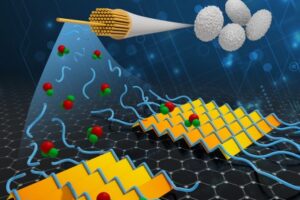
Individual silk protein molecules, or “silk fibroins” (blue), are deposited on a graphene surface surrounded by water (green and red spheres) and grow into an atomically precise two-dimensional (2D) sheet. Controlled deposition of silk fibers could lead to numerous biodegradable electronic devices.

Silk and Graphene Fusion: A New Era for Flexible Electronics

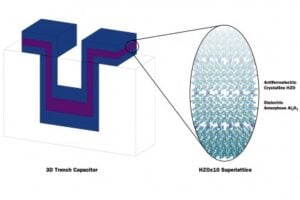
Microcapacitors made with engineered hafnium oxide/zirconium oxide films in 3D trench capacitor structures -- the same structures used in modern microelectronics -- achieve record-high energy storage and power density, paving the way for on-chip energy storage.

Groundbreaking Microcapacitors Could Power Chips of the Future

Substack subscription form sign up

Comments

  • Norwood johnson on Electrons in New Crystals Behave as If They Live in Four Dimensions
  • ScienceBlog.com on Hidden Geometry Could Finally Fix Quantum Computers
  • Theo Prinse on America Is Going Back to the Moon. This Time, It Plans to Stay
  • george w on Hidden Geometry Could Finally Fix Quantum Computers
  • Tom Hughes on Years of Exercise, Blood Pressure Drugs Failed to Slow Cognitive Decline in Seniors at Dementia Risk
© 2026 ScienceBlog.com | Follow our RSS / XML feed