Skip to content
ScienceBlog.com
  • Featured Blogs
    • EU Horizon Blog
    • ESA Tracker
    • Experimental Frontiers
    • Josh Mitteldorf’s Aging Matters
    • Dr. Lu Zhang’s Gondwanaland
    • NeuroEdge
    • NIAAA
    • SciChi
    • The Poetry of Science
    • Wild Science
  • Topics
    • Brain & Behavior
    • Earth, Energy & Environment
    • Health
    • Life & Non-humans
    • Physics & Mathematics
    • Social Sciences
    • Space
    • Technology
  • Our Substack
  • Follow Us!
    • Bluesky
    • Threads
    • FaceBook
    • Google News
    • Twitter/X
  • Contribute/Contact

microplastics

pregnant woman's stomach

Preterm Babies’ Placentas Harbor Higher Levels of Microplastics

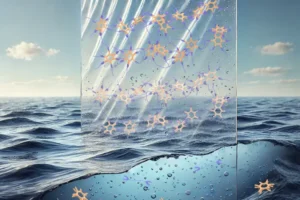
Artistic rendering of the new plastic. Cross linked salt bridges visible in the plastic outside the seawater give it its structure and strength. In seawater (and in soil, not depicted), resalting destroys the bridges, prevending microplastic formation and allowing the plastic to become biodegradable.

Scientists Create Plastic That Safely Dissolves in Seawater, Preventing Microplastic Pollution

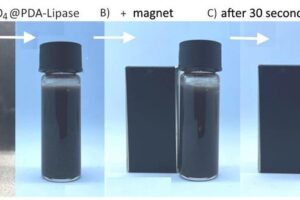
Summary of purification process: water polluted by microplastics (PET); addition of magnetic nanoparticles functionalized with polydopamine and lipase; removal of nanoparticles with microplastics using a magnet

Magnetic Nanoparticles: A Novel Solution for Removing Dangerous Microplastics from Water

city scene during rain

Microplastics in the Sky: How Tiny Plastic Particles May Be Reshaping Our Weather

dolphin closeup

Microplastics detected in dolphin breath

Ohio State logo

Scientists develop novel method for strengthening PVC products

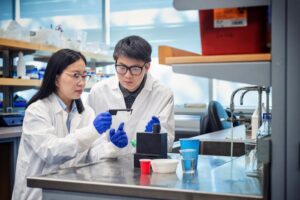
Dr. Tianxi Yang and student Peter Yang with the tool they created to test micro- and nanoplastics.

New Portable Device Detects Invisible Plastic Particles in Your Drinks

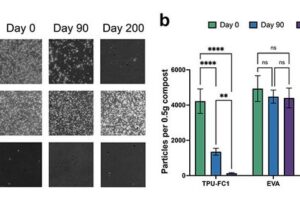
Particle counts of petroleum-based (EVA) and plant-based (TPU-FC1) microplastics show that, over time, EVAs exhibit virtually no biodegradation, while the TPUs have mostly disappeared by day 200.

Plant-Based Plastics Biodegrade in Months, Not Centuries

Specks of orange on a black background

Microplastics cause behavioral changes

Open-heart surgery. Pixabay

Microplastics found in human heart tissues, both before and after surgical procedures

Microscopic photo of PA12, a marine microplastic pollutant.

Using optics to trace the flow of microplastics in oceans

Soil and freshwater come under the spotlight in plastics-pollution fight

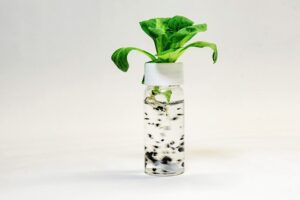
Lettuce plants take up chemicals that are released by tyre abrasion: The picture shows the actual experimental setup in which the researchers added tyre abrasion to the nutrient solutions of lettuce plants.

From the road to the plate: lettuce takes up toxic additives from tire wear

plastic particles

Breathing Plastic

Older posts
Page1 Page2 Next →
Substack subscription form sign up

Comments

  • Karoly Mirnics on Common Prescription Drugs May Disrupt Cholesterol Pathways in the Womb and Raise Autism Risk
  • Aizen on Laziness helped lead to extinction of Homo erectus
  • Norwood johnson on Electrons in New Crystals Behave as If They Live in Four Dimensions
  • ScienceBlog.com on Hidden Geometry Could Finally Fix Quantum Computers
  • Theo Prinse on America Is Going Back to the Moon. This Time, It Plans to Stay
© 2026 ScienceBlog.com | Follow our RSS / XML feed