Skip to content
ScienceBlog.com
  • Featured Blogs
    • EU Horizon Blog
    • ESA Tracker
    • Experimental Frontiers
    • Josh Mitteldorf’s Aging Matters
    • Dr. Lu Zhang’s Gondwanaland
    • NeuroEdge
    • NIAAA
    • SciChi
    • The Poetry of Science
    • Wild Science
  • Topics
    • Brain & Behavior
    • Earth, Energy & Environment
    • Health
    • Life & Non-humans
    • Physics & Mathematics
    • Social Sciences
    • Space
    • Technology
  • Our Substack
  • Follow Us!
    • Bluesky
    • Threads
    • FaceBook
    • Google News
    • Twitter/X
  • Contribute/Contact

Molecular clouds

NASA’s SPHEREx mission will survey the Milky Way galaxy looking for water ice and other key ingredients for life. In the search for these frozen compounds, the mission will focus on molecular clouds — collections of gas and dust in space — like this one imaged by the agency’s James Webb Space Telescope. Credit: NASA, ESA, CSA

NASA’s New Space Telescope to Hunt for Ice That Could Harbor Life’s Origins

Dr Serge Krasnokutski

Cosmic Dust Particles May Hold Key to Life’s Building Blocks

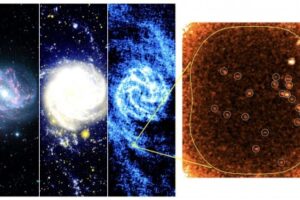
Research on the far edge of galaxy M83 reveals unusual star formation in an extreme environment. This area, outlined in yellow, is shown in data from several different instruments. From left to right: optical image from CTIO, ultraviolet image from GALEX, HI 21cm image from VLA and GBT, and CO(3-2) image from ALMA. In this last image, the star-forming “hearts” of molecular clouds, circled with white, are shown.

Mystery of Star Formation Revealed by Hearts of Molecular Clouds

Substack subscription form sign up

Comments

  • Not Buying Yer Bullshit on More Than a Third of Americans Have Lost Relationships Over Politics
  • Marco Messina on More Than a Third of Americans Have Lost Relationships Over Politics
  • Anon on Why Fructose Behaves Less Like a Calorie and More Like a Hormone
  • Mark Mellinger on Living Plastic Can Self-Destruct on Command
  • Marie Feret on The Silent Frequency That Makes Old Buildings Feel Haunted
© 2026 ScienceBlog.com | Follow our RSS / XML feed