Skip to content
ScienceBlog.com
  • Featured Blogs
    • EU Horizon Blog
    • ESA Tracker
    • Experimental Frontiers
    • Josh Mitteldorf’s Aging Matters
    • Dr. Lu Zhang’s Gondwanaland
    • NeuroEdge
    • NIAAA
    • SciChi
    • The Poetry of Science
    • Wild Science
  • Topics
    • Brain & Behavior
    • Earth, Energy & Environment
    • Health
    • Life & Non-humans
    • Physics & Mathematics
    • Social Sciences
    • Space
    • Technology
  • Our Substack
  • Follow Us!
    • Bluesky
    • Threads
    • FaceBook
    • Google News
    • Twitter/X
  • Contribute/Contact

Nebula

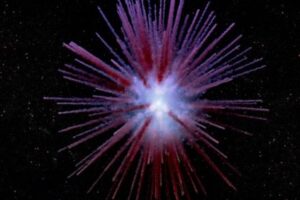
Artist's illustration of filaments extending from a supernova witnessed in the year 1181.

Ancient Supernova’s ‘Dandelion Petals’ Mapped in 3D for First Time

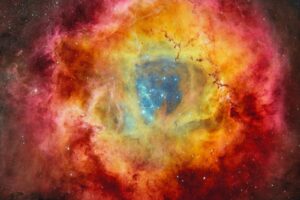
Cradled within the fiery petals of the Rosette Nebula is NGC 2244, the young star cluster which it nurtured. The cluster’s stars light up the nebula in vibrant hues of red, gold and purple, and opaque towers of dust rise from the billowing clouds around its excavated core. This image, captured by 570-megapixel Department of Energy-fabricated Dark Energy Camera (DECam), mounted on the U.S. National Science Foundation Víctor M. Blanco 4-meter Telescope at Cerro Tololo Inter-American Observatory, a Program of NSF NOIRLab, is being released in celebration of NOIRLab’s fifth anniversary.

Radiant Stars at the Heart of a Cosmic Rose

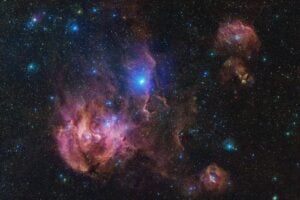
The Running Chicken Nebula comprises several clouds, all of which we can see in this vast image from the VLT Survey Telescope (VST), hosted at ESO’s Paranal site. This 1.5-billion pixel image spans an area in the sky of about 25 full Moons. The clouds shown in wispy pink plumes are full of gas and dust, illuminated by the young and hot stars within them.

New 1.5-billion-pixel image shows Running Chicken in unprecedented detail

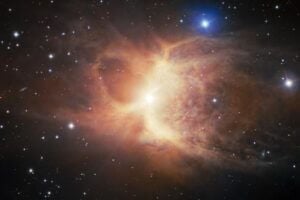
A billowing pair of nearly symmetrical loops of dust and gas mark the death throes of an ancient red-giant star, as captured by Gemini South, one half of the International Gemini Observatory, operated by NSF’s NOIRLab. The resulting structure, said to resemble an old style of English jug, is a rarely seen bipolar reflection nebula. Evidence suggests that this object formed by the interactions between the dying red giant and a now-shredded companion star. The image was obtained by NOIRLab’s Communication, Education & Engagement team as part of the NOIRLab Legacy Imaging Program.

Rare, double-lobe nebula resembles overflowing cosmic ‘jug’

Substack subscription form sign up

Comments

  • Karoly Mirnics on Common Prescription Drugs May Disrupt Cholesterol Pathways in the Womb and Raise Autism Risk
  • Aizen on Laziness helped lead to extinction of Homo erectus
  • Norwood johnson on Electrons in New Crystals Behave as If They Live in Four Dimensions
  • ScienceBlog.com on Hidden Geometry Could Finally Fix Quantum Computers
  • Theo Prinse on America Is Going Back to the Moon. This Time, It Plans to Stay
© 2026 ScienceBlog.com | Follow our RSS / XML feed