Skip to content
ScienceBlog.com
  • Featured Blogs
    • EU Horizon Blog
    • ESA Tracker
    • Experimental Frontiers
    • Josh Mitteldorf’s Aging Matters
    • Dr. Lu Zhang’s Gondwanaland
    • NeuroEdge
    • NIAAA
    • SciChi
    • The Poetry of Science
    • Wild Science
  • Topics
    • Brain & Behavior
    • Earth, Energy & Environment
    • Health
    • Life & Non-humans
    • Physics & Mathematics
    • Social Sciences
    • Space
    • Technology
  • Our Substack
  • Follow Us!
    • Bluesky
    • Threads
    • FaceBook
    • Google News
    • Twitter/X
  • Contribute/Contact

Neurodevelopmental Disorder

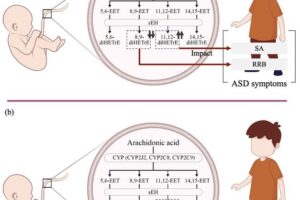
Arachidonic acid, which is released from phospholipid membranes, is metabolized to various epoxyeicosatrienoic acid (EET) compounds and subsequently to dihydroxyeicosatrienoic acids (diHETrE). This study revealed that high levels of 11,12- diHETrE in umbilical cord blood are associated with ASD symptoms, such as social affect (SA) and adaptive functioning. Additionally, lower levels of 8,9-diHETrE impacted repetitive/restrictive behaviors (RRB).

Fatty acids in umbilical cord blood might cause autism spectrum disorder

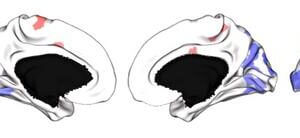
Brain areas with the greatest difference between individuals with and without schizophrenia, with a pronounced negative effect in visual areas of the brain.

Brain connectivity is disrupted in schizophrenia

Substack subscription form sign up

Comments

  • Brunette Keller on How New Herpes Drugs Jam a Virus’s Replication Engine
  • Aizen on Laziness helped lead to extinction of Homo erectus
  • Norwood johnson on Electrons in New Crystals Behave as If They Live in Four Dimensions
  • ScienceBlog.com on Hidden Geometry Could Finally Fix Quantum Computers
  • Theo Prinse on America Is Going Back to the Moon. This Time, It Plans to Stay
© 2026 ScienceBlog.com | Follow our RSS / XML feed