Skip to content
ScienceBlog.com
  • Featured Blogs
    • EU Horizon Blog
    • ESA Tracker
    • Experimental Frontiers
    • Josh Mitteldorf’s Aging Matters
    • Dr. Lu Zhang’s Gondwanaland
    • NeuroEdge
    • NIAAA
    • SciChi
    • The Poetry of Science
    • Wild Science
  • Topics
    • Brain & Behavior
    • Earth, Energy & Environment
    • Health
    • Life & Non-humans
    • Physics & Mathematics
    • Social Sciences
    • Space
    • Technology
  • Our Substack
  • Follow Us!
    • Bluesky
    • Threads
    • FaceBook
    • Google News
    • Twitter/X
  • Contribute/Contact

neurodevelopmental disorders

illustration of mice and DNA

Drug Restores Social Communication in Fragile X Newborns

Researchers have formed a consortium called SSPsyGene with the shared objective of studying the genetic causes of neurodevelopmental and psychiatric disorders (NPD). Their focus is on 250 high-risk genes that may contribute to these conditions. In the project's initial phase, they tested 23 of these risk genes. The stem cell lines they generated from this research will be shared globally to aid other scientists in studying how these genes contribute to NPD.

Scientists aim to decode the genetic roots of mental illness on a large scale

In the Drosophila brain, dormant neural stem cells with protrusions rich in actin filaments.

Scientists find breakthrough method to activate dormant stem cells in the brain

A genetic diagnostic method using a small sample of skin from the upper arm could identify rare neurodevelopmental disorders in a non-invasive way, according to researchers at the University of Adelaide.

Skin may hold key to neurodevelopmental disorder diagnosis

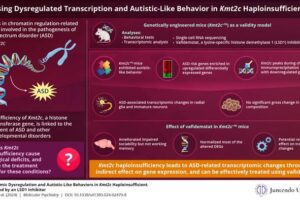
Genes involved in chromatin modification and gene transcription are associated with the progression of neurodevelopmental disorders. Researchers from Japan have developed a new mouse model to study the molecular mechanism behind the ability of KMT2C to cause autism spectrum disorder. They also showed that vafidemstat has a rescuing effect by normalizing disrupted gene expression.

New study uncovers how altered gene expression can induce autism

Bizarre brain development illustration.

Scientists develop game-changing organoid model to study human brain development

Autism cures may be closer as focus turns to early treatment

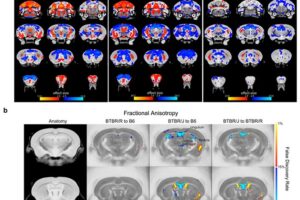
a. Brain structure comparisons of the following mice: Left: BTBR/R and B6 (normal mouse), Center: Comparison of BTBR/J and B6, Right: BTBR/J and BTBR/R. b. Diffusion tensor imaging to compare differences in nerve fibers. Red indicates the brain regions that were either bigger or had increased numbers of nerve fibers in BTBR/J mice in comparison to either B6 (left and center images) or BTBR/R (right image). Conversely, blue indicates brain regions in BTBR/J mice that were comparatively smaller or had decreased numbers of nerve fibers. These scans revealed particularly significant differences between BTBR/J and BTBR/R mice’s corpus callosum.

Ancient virus genome drives autism?

Gut illustration

Drug targeting gut bacteria may improve irritability in teens with autism

Substack subscription form sign up

Comments

  • Norwood johnson on Electrons in New Crystals Behave as If They Live in Four Dimensions
  • ScienceBlog.com on Hidden Geometry Could Finally Fix Quantum Computers
  • Theo Prinse on America Is Going Back to the Moon. This Time, It Plans to Stay
  • george w on Hidden Geometry Could Finally Fix Quantum Computers
  • Tom Hughes on Years of Exercise, Blood Pressure Drugs Failed to Slow Cognitive Decline in Seniors at Dementia Risk
© 2026 ScienceBlog.com | Follow our RSS / XML feed