Skip to content
ScienceBlog.com
  • Featured Blogs
    • EU Horizon Blog
    • ESA Tracker
    • Experimental Frontiers
    • Josh Mitteldorf’s Aging Matters
    • Dr. Lu Zhang’s Gondwanaland
    • NeuroEdge
    • NIAAA
    • SciChi
    • The Poetry of Science
    • Wild Science
  • Topics
    • Brain & Behavior
    • Earth, Energy & Environment
    • Health
    • Life & Non-humans
    • Physics & Mathematics
    • Social Sciences
    • Space
    • Technology
  • Our Substack
  • Follow Us!
    • Bluesky
    • Threads
    • FaceBook
    • Google News
    • Twitter/X
  • Contribute/Contact

neutrinos

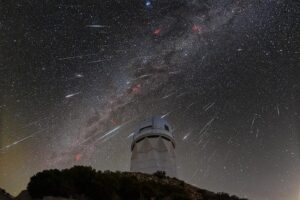
DESI observes the sky from the Mayall Telescope, shown here during the 2023 Geminid meteor shower.

DESI’s Galactic Survey Confirms Einstein’s Theory of Gravity at Cosmic Scales

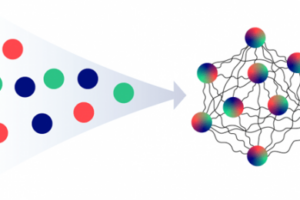
Neutrinos of different “flavor” quantum states (shown by colors) are entangled through interactions. In dense neutrino environments like core-collapse supernovae, this leads neutrinos of different flavors to equilibrate to similar energy distributions.

Neutrino Entanglement: A New Twist in Supernova Physics

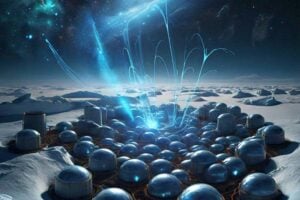
An artistic rendering of ultra-high energy neutrinos passing through the Earth, with the IceCube Observatory sensors deep in the Antarctic glacier at the south pole.

Quantum Gravity Remains Elusive as Ultra-High Energy Neutrinos Show No Signs of Spacetime Fluctuations

Ohio State logo

Using supernovae to study neutrinos’ strange properties

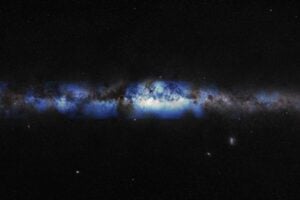
Milky Way seen through a neutrino lens (blue)

The first neutrino image of our galaxy

Substack subscription form sign up

Comments

  • Sue Ann Hayes on Hidden Nuclear Protein Fuels Pancreatic Cancer’s Deadly Aggression
  • Curtis Webber on The GPS-Killer? This Quantum Device ‘Feels’ Motion Like a Brain—Down to the Atomic Level
  • Ran on How the Age You First Had Sex Could Shape How You Age Decades Later
  • Sparty on How the Age You First Had Sex Could Shape How You Age Decades Later
  • Josh Mitteldorf on A Single TV Segment Sent Leucovorin Prescriptions for Autistic Children Soaring 2,000 Percent
© 2026 ScienceBlog.com | Follow our RSS / XML feed