Skip to content
ScienceBlog.com
  • Featured Blogs
    • EU Horizon Blog
    • ESA Tracker
    • Experimental Frontiers
    • Josh Mitteldorf’s Aging Matters
    • Dr. Lu Zhang’s Gondwanaland
    • NeuroEdge
    • NIAAA
    • SciChi
    • The Poetry of Science
    • Wild Science
  • Topics
    • Brain & Behavior
    • Earth, Energy & Environment
    • Health
    • Life & Non-humans
    • Physics & Mathematics
    • Social Sciences
    • Space
    • Technology
  • Our Substack
  • Follow Us!
    • Bluesky
    • Threads
    • FaceBook
    • Google News
    • Twitter/X
  • Contribute/Contact

neutron star

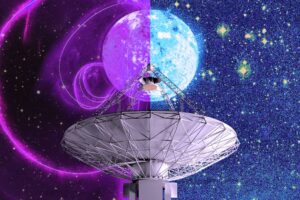
Artist’s depiction of CSIRO’s ASKAP radio telescope with two versions of the mysterious celestial object: neutron star or white dwarf

Astronomers Discover Slowest Spinning Neutron Star, Defying Expectations

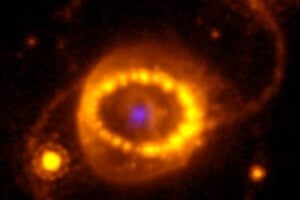
Fig. 1. Combination of a Hubble image of SN 1987A and the compact highly ionized argon source in Fig. 2. The faint blue source in the centre was detected by the NIRSpec instrument on JWST. Outside of this is the rest of the supernova, which contains the most mass and is expanding at thousands of kilometers every second. The inner bright "string of pearls" is gas from the star's outer layers that was ejected about 20,000 years before the explosion. The collision between the rapidly expanding supernova remnant and the ring gives rise to the heated clumps in the ring. Outside the inner ring are two outer rings, which probably arose at the same time as the inner ring was formed. The bright stars to the left and right of the inner ring are unrelated to the supernova. (Illustration: HST, JWST/NIRSpec, J. Larsson)

James Webb telescope detects neutron star in the remnant of a supernova

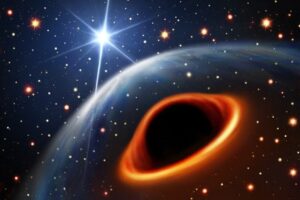
An artist’s impression of the system assuming that the massive companion star is a black hole. The brightest background star is its orbital companion, the radio pulsar PSR J0514-4002E. The two stars are separated by 8 million km and orbit each other every 7 days.

Astronomers Discover Most Massive Neutron Star—or Least Massive Black Hole

Substack subscription form sign up

Comments

  • Brunette Keller on How New Herpes Drugs Jam a Virus’s Replication Engine
  • Aizen on Laziness helped lead to extinction of Homo erectus
  • Norwood johnson on Electrons in New Crystals Behave as If They Live in Four Dimensions
  • ScienceBlog.com on Hidden Geometry Could Finally Fix Quantum Computers
  • Theo Prinse on America Is Going Back to the Moon. This Time, It Plans to Stay
© 2026 ScienceBlog.com | Follow our RSS / XML feed