Skip to content
ScienceBlog.com
  • Featured Blogs
    • EU Horizon Blog
    • ESA Tracker
    • Experimental Frontiers
    • Josh Mitteldorf’s Aging Matters
    • Dr. Lu Zhang’s Gondwanaland
    • NeuroEdge
    • NIAAA
    • SciChi
    • The Poetry of Science
    • Wild Science
  • Topics
    • Brain & Behavior
    • Earth, Energy & Environment
    • Health
    • Life & Non-humans
    • Physics & Mathematics
    • Social Sciences
    • Space
    • Technology
  • Our Substack
  • Follow Us!
    • Bluesky
    • Threads
    • FaceBook
    • Google News
    • Twitter/X
  • Contribute/Contact

Organic molecules

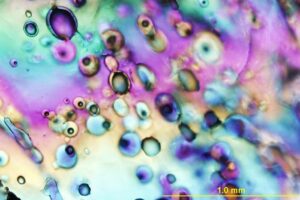
SwRI researchers are expanding corrosion modeling software to predict if icy worlds such as Saturn’s moon Enceladus may be able to harbor microbial life. In this cross-polarized light microscope image, pores are visible in glycine-doped ice formed in a laboratory investigation of Enceladus’ subsurface conditions. These pores could form habitable niches for microbial life.

Scientists Use Corrosion Modeling to Study Habitability on Saturn’s Icy Moon

NASA’s Perseverance Mars rover uses SHERLOC – one of several instruments on the end of its robotic arm – to study rocks in an area nicknamed “Skinner Ridge.” Credit: NASA/JPL-Caltech/ASU/MSSS

NASA’s Perseverance Rover Sees Mars in a New Light

The galaxy observed by Webb shows an Einstein ring caused by a phenomenon known as lensing, which occurs when two galaxies are almost perfectly aligned from our perspective on Earth. The gravity from the galaxy in the foreground causes the light from the background galaxy to be distorted and magnified, like looking through the stem of a wine glass. Because they are magnified, lensing allows astronomers to study very distant galaxies in more detail than otherwise possible.

Webb telescope detects universe’s most distant organic molecules

UVB has many uses today but requires inefficient and toxic sources to produce. A collaborative effort involving Kyushu University and Johannes Gutenberg University Mainz developed a system where blue LED light is upconverted to UVB light. Moreover, the system uses only organic materials, opening the door for a more sustainable and ecofriendly method of generating UVB light.

Turning blue light into useful UVB
Substack subscription form sign up

Comments

  • Norwood johnson on Electrons in New Crystals Behave as If They Live in Four Dimensions
  • ScienceBlog.com on Hidden Geometry Could Finally Fix Quantum Computers
  • Theo Prinse on America Is Going Back to the Moon. This Time, It Plans to Stay
  • george w on Hidden Geometry Could Finally Fix Quantum Computers
  • Tom Hughes on Years of Exercise, Blood Pressure Drugs Failed to Slow Cognitive Decline in Seniors at Dementia Risk
© 2026 ScienceBlog.com | Follow our RSS / XML feed