Skip to content
ScienceBlog.com
  • Featured Blogs
    • EU Horizon Blog
    • ESA Tracker
    • Experimental Frontiers
    • Josh Mitteldorf’s Aging Matters
    • Dr. Lu Zhang’s Gondwanaland
    • NeuroEdge
    • NIAAA
    • SciChi
    • The Poetry of Science
    • Wild Science
  • Topics
    • Brain & Behavior
    • Earth, Energy & Environment
    • Health
    • Life & Non-humans
    • Physics & Mathematics
    • Social Sciences
    • Space
    • Technology
  • Our Substack
  • Follow Us!
    • Bluesky
    • Threads
    • FaceBook
    • Google News
    • Twitter/X
  • Contribute/Contact

Particle Accelerators

Artist’s depiction of the spray of particles arising from the collision of two heavy atoms. As the hot subatomic soup cools, newly formed particles shower off into space.

Discovery Sheds Light on the Origins of Matter in the Early Universe

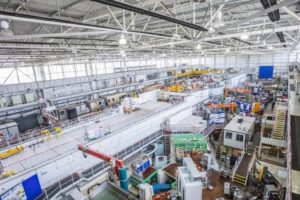
ISIS Neutron & Muon Source at the STFC Rutherford Appleton Laboratory in the UK

Muon Colliders: The Next Frontier in Particle Physics

Illustration of pair plasma in a beaker

Pair plasmas found in deep space can now be generated in the lab

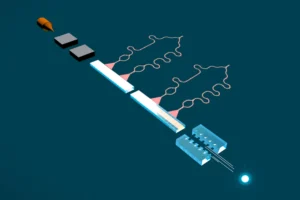
Illustration of a shoebox-sized accelerator. An electron source and buncher/injector feeds into a sub-relativistic DLA (the device described in this article), which accelerates electrons up to 1MeV in energy. These electrons are further accelerated by SiO2 waveguide-driven relativistic DLA, and finally pass through an undulator to produce coherent free-electron radiation. (Image credit: Moore Foundation / Payton Broaddus)

Steering and accelerating electrons at the microchip scale

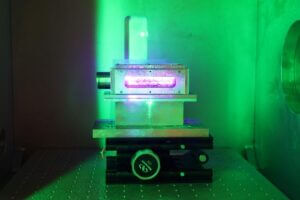
This gas cell is a key component of a compact wakefield laser accelerator developed at The University of Texas at Austin. Inside, an extremely powerful laser strikes helium gas, heats it into a plasma and creates waves that kick electrons from the gas out in a high-energy electron beam.

Compact accelerator technology achieves major energy milestone

Substack subscription form sign up

Comments

  • Norwood johnson on Electrons in New Crystals Behave as If They Live in Four Dimensions
  • ScienceBlog.com on Hidden Geometry Could Finally Fix Quantum Computers
  • Theo Prinse on America Is Going Back to the Moon. This Time, It Plans to Stay
  • george w on Hidden Geometry Could Finally Fix Quantum Computers
  • Tom Hughes on Years of Exercise, Blood Pressure Drugs Failed to Slow Cognitive Decline in Seniors at Dementia Risk
© 2026 ScienceBlog.com | Follow our RSS / XML feed