Skip to content
ScienceBlog.com
  • Featured Blogs
    • EU Horizon Blog
    • ESA Tracker
    • Experimental Frontiers
    • Josh Mitteldorf’s Aging Matters
    • Dr. Lu Zhang’s Gondwanaland
    • NeuroEdge
    • NIAAA
    • SciChi
    • The Poetry of Science
    • Wild Science
  • Topics
    • Brain & Behavior
    • Earth, Energy & Environment
    • Health
    • Life & Non-humans
    • Physics & Mathematics
    • Social Sciences
    • Space
    • Technology
  • Our Substack
  • Follow Us!
    • Bluesky
    • Threads
    • FaceBook
    • Google News
    • Twitter/X
  • Contribute/Contact

plasma

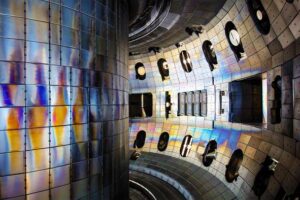
The inside of the DIII-D fusion vessel. The iridescent hues seen on some tiles lining the vessel come from atoms that can become lodged in the walls during plasma experiments.

The Fusion Puzzle: Why Fusion Walls Are Secretly Hoarding Vital Fuel

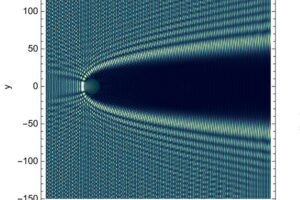
Medvedev modeled wave diffraction off a circular reflecting region with radially varying index of refraction outside of it to better understand the Crab Nebula’s zebra pattern.

Physicist Solves Mystery of Crab Nebula’s Unique ‘Zebra’ Pattern

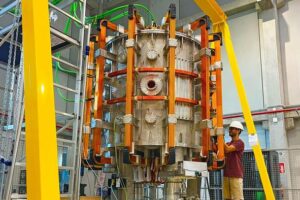
SMall Aspect Ratio Tokamak (SMART) is being built at the University of Seville in Spain, in collaboration with Princeton Plasma Physics Laboratory. (Photo credit: University of Seville)

A new and unique fusion reactor comes together

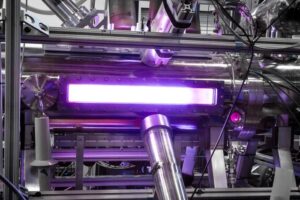
A bright flash of light from a FuZE (Fusion Z-pinch Experiment) plasma.

Zap Energy’s Compact Fusion Device Achieves Breakthrough Plasma Temperatures

Substack subscription form sign up

Comments

  • Not Buying Yer Bullshit on More Than a Third of Americans Have Lost Relationships Over Politics
  • Marco Messina on More Than a Third of Americans Have Lost Relationships Over Politics
  • Anon on Why Fructose Behaves Less Like a Calorie and More Like a Hormone
  • Mark Mellinger on Living Plastic Can Self-Destruct on Command
  • Marie Feret on The Silent Frequency That Makes Old Buildings Feel Haunted
© 2026 ScienceBlog.com | Follow our RSS / XML feed