Skip to content
ScienceBlog.com
  • Featured Blogs
    • EU Horizon Blog
    • ESA Tracker
    • Experimental Frontiers
    • Josh Mitteldorf’s Aging Matters
    • Dr. Lu Zhang’s Gondwanaland
    • NeuroEdge
    • NIAAA
    • SciChi
    • The Poetry of Science
    • Wild Science
  • Topics
    • Brain & Behavior
    • Earth, Energy & Environment
    • Health
    • Life & Non-humans
    • Physics & Mathematics
    • Social Sciences
    • Space
    • Technology
  • Our Substack
  • Follow Us!
    • Bluesky
    • Threads
    • FaceBook
    • Google News
    • Twitter/X
  • Contribute/Contact

precision

Like the teeth of a comb, a microcomb consists of a spectrum of evenly distributed light frequencies. Optical atomic clocks can be built by locking a microcomb tooth to a ultranarrow-linewidth laser, which in turn locks to an atomic transition with extremely high frequency stability. That way, frequency combs act like a bridge between the atomic transition at an optical frequency and the clock signal at a radio frequency that is electronically detectable for counting the oscillations – enabling extraordinary precision. The researchers’ photonic chip, on the righthand side of the image, contains 40 microcombs generators and is only five millimeters wide.

Tiny Light-Based Chips Could Make Your GPS Accurate to the Centimeter

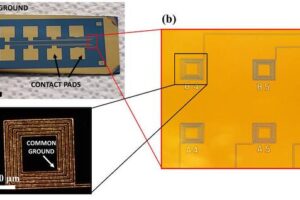
A microscopic view of the MagPatch array showing six of the eight microcoils used for nerve stimulation.

Microcoil Arrays Offer Targeted Treatment for Nervous System Disorders

Substack subscription form sign up

Comments

  • Norwood johnson on Electrons in New Crystals Behave as If They Live in Four Dimensions
  • ScienceBlog.com on Hidden Geometry Could Finally Fix Quantum Computers
  • Theo Prinse on America Is Going Back to the Moon. This Time, It Plans to Stay
  • george w on Hidden Geometry Could Finally Fix Quantum Computers
  • Tom Hughes on Years of Exercise, Blood Pressure Drugs Failed to Slow Cognitive Decline in Seniors at Dementia Risk
© 2026 ScienceBlog.com | Follow our RSS / XML feed