Skip to content
ScienceBlog.com
  • Featured Blogs
    • EU Horizon Blog
    • ESA Tracker
    • Experimental Frontiers
    • Josh Mitteldorf’s Aging Matters
    • Dr. Lu Zhang’s Gondwanaland
    • NeuroEdge
    • NIAAA
    • SciChi
    • The Poetry of Science
    • Wild Science
  • Topics
    • Brain & Behavior
    • Earth, Energy & Environment
    • Health
    • Life & Non-humans
    • Physics & Mathematics
    • Social Sciences
    • Space
    • Technology
  • Our Substack
  • Follow Us!
    • Bluesky
    • Threads
    • FaceBook
    • Google News
    • Twitter/X
  • Contribute/Contact

Protein Modification

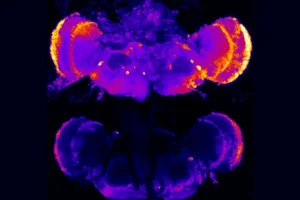
Mutations in the presenilin gene, PSEN1, causes early onset of Alzheimer’s disease in humans and in fruit flies modified to have this gene. A new study led by researchers at Penn State revels that disrupting heparan sulfate–modified proteins in fruit flies suppressed neuronal death and corrected other cell deficits common in early stages of Alzheimer’s and other neurodegenerative diseases. Pictured here are full fruit fly brains, stained with a marker that indicates cell death—brighter colors indicate higher presence of cell death. Top: A fly with deficits in the presenilin gene—a model for Alzheimer’s disease—with high levels of cell death. Bottom: A fly rescued by disrupting heparan sulfate–modified proteins.

Potential new target for early treatment of Alzheimer’s disease

Substack subscription form sign up

Comments

  • Norwood johnson on Electrons in New Crystals Behave as If They Live in Four Dimensions
  • ScienceBlog.com on Hidden Geometry Could Finally Fix Quantum Computers
  • Theo Prinse on America Is Going Back to the Moon. This Time, It Plans to Stay
  • george w on Hidden Geometry Could Finally Fix Quantum Computers
  • Tom Hughes on Years of Exercise, Blood Pressure Drugs Failed to Slow Cognitive Decline in Seniors at Dementia Risk
© 2026 ScienceBlog.com | Follow our RSS / XML feed