Skip to content
ScienceBlog.com
  • Featured Blogs
    • EU Horizon Blog
    • ESA Tracker
    • Experimental Frontiers
    • Josh Mitteldorf’s Aging Matters
    • Dr. Lu Zhang’s Gondwanaland
    • NeuroEdge
    • NIAAA
    • SciChi
    • The Poetry of Science
    • Wild Science
  • Topics
    • Brain & Behavior
    • Earth, Energy & Environment
    • Health
    • Life & Non-humans
    • Physics & Mathematics
    • Social Sciences
    • Space
    • Technology
  • Our Substack
  • Follow Us!
    • Bluesky
    • Threads
    • FaceBook
    • Google News
    • Twitter/X
  • Contribute/Contact

Pulsar

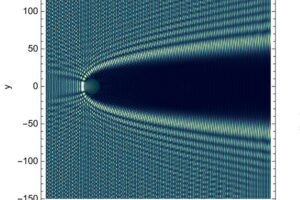
Medvedev modeled wave diffraction off a circular reflecting region with radially varying index of refraction outside of it to better understand the Crab Nebula’s zebra pattern.

Physicist Solves Mystery of Crab Nebula’s Unique ‘Zebra’ Pattern

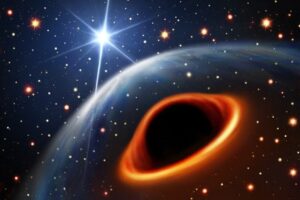
An artist’s impression of the system assuming that the massive companion star is a black hole. The brightest background star is its orbital companion, the radio pulsar PSR J0514-4002E. The two stars are separated by 8 million km and orbit each other every 7 days.

Astronomers Discover Most Massive Neutron Star—or Least Massive Black Hole

Substack subscription form sign up

Comments

  • Anon on Why Fructose Behaves Less Like a Calorie and More Like a Hormone
  • Mark Mellinger on Living Plastic Can Self-Destruct on Command
  • Marie Feret on The Silent Frequency That Makes Old Buildings Feel Haunted
  • Dax on The Silent Frequency That Makes Old Buildings Feel Haunted
  • Karoly Mirnics on Common Prescription Drugs May Disrupt Cholesterol Pathways in the Womb and Raise Autism Risk
© 2026 ScienceBlog.com | Follow our RSS / XML feed