Skip to content
ScienceBlog.com
  • Featured Blogs
    • EU Horizon Blog
    • ESA Tracker
    • Experimental Frontiers
    • Josh Mitteldorf’s Aging Matters
    • Dr. Lu Zhang’s Gondwanaland
    • NeuroEdge
    • NIAAA
    • SciChi
    • The Poetry of Science
    • Wild Science
  • Topics
    • Brain & Behavior
    • Earth, Energy & Environment
    • Health
    • Life & Non-humans
    • Physics & Mathematics
    • Social Sciences
    • Space
    • Technology
  • Our Substack
  • Follow Us!
    • Bluesky
    • Threads
    • FaceBook
    • Google News
    • Twitter/X
  • Contribute/Contact

quantum calculations

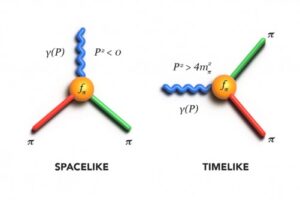
An early-career physicist mathematically connects timelike and spacelike form factors, opening the door to further insights into the inner workings of the strong force. A new lattice QCD calculation connects two seemingly disparate reactions involving the pion, the lightest particle governed by the strong interaction. One reaction is known as the spacelike process, where an electron is bounced off a pion. The second reaction, known as the timelike process, is when an electron and antielectron collide, annihilate each other, and produce two pions. The lattice QCD numerical calculation is simultaneously able to describe the spacelike and timelike processes, demonstrating the interconnectedness of different reactions described by QCD. While this connection had been observed experimentally, now physicists have the math to corroborate it.

Physicists Crack the Code Between Matter and Antimatter Collisions in Groundbreaking Calculation

Substack subscription form sign up

Comments

  • Norwood johnson on Electrons in New Crystals Behave as If They Live in Four Dimensions
  • ScienceBlog.com on Hidden Geometry Could Finally Fix Quantum Computers
  • Theo Prinse on America Is Going Back to the Moon. This Time, It Plans to Stay
  • george w on Hidden Geometry Could Finally Fix Quantum Computers
  • Tom Hughes on Years of Exercise, Blood Pressure Drugs Failed to Slow Cognitive Decline in Seniors at Dementia Risk
© 2026 ScienceBlog.com | Follow our RSS / XML feed