Skip to content
ScienceBlog.com
  • Featured Blogs
    • EU Horizon Blog
    • ESA Tracker
    • Experimental Frontiers
    • Josh Mitteldorf’s Aging Matters
    • Dr. Lu Zhang’s Gondwanaland
    • NeuroEdge
    • NIAAA
    • SciChi
    • The Poetry of Science
    • Wild Science
  • Topics
    • Brain & Behavior
    • Earth, Energy & Environment
    • Health
    • Life & Non-humans
    • Physics & Mathematics
    • Social Sciences
    • Space
    • Technology
  • Our Substack
  • Follow Us!
    • Bluesky
    • Threads
    • FaceBook
    • Google News
    • Twitter/X
  • Contribute/Contact

Quantum Entanglement

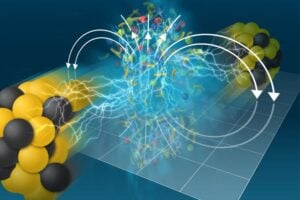
illustration of new type of entanglement

Researchers Discover a New Type of Quantum Entanglement

Collisions of heavy ions generate an immensely strong electromagnetic field. Scientists investigate traces of this powerful electromagnetic field in the quark-gluon plasma (QGP), a state where quarks and gluons are liberated from the colliding protons and neutrons.

‘Spooky Action’ at a Very Short Distance: Scientists Map Out Quantum Entanglement in Protons

An atom is hit by a laser pulse. One electron is ripped out of the atom, another electron is shifted into a state with higher energy.

Scientists Track Quantum Entanglement at Nature’s Fastest Timescale

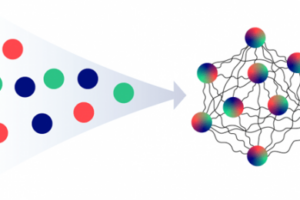
Neutrinos of different “flavor” quantum states (shown by colors) are entangled through interactions. In dense neutrino environments like core-collapse supernovae, this leads neutrinos of different flavors to equilibrate to similar energy distributions.

Neutrino Entanglement: A New Twist in Supernova Physics

An AI-generated image showing a visual representation of quantum entanglement, with colorful, intertwined threads or particles on a dark background, symbolizing the complex connections and transformations described in the article.

Scientists Uncover the “Entropy” of Quantum Entanglement

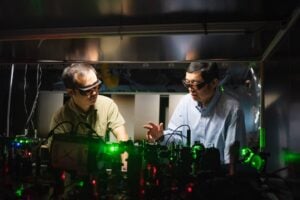
Laser setup for cooling, controlling, and entangling individual molecules. Photo by Richard Soden, Department of Physics

Physicists ‘entangle’ individual molecules for the first time

Using a "spooky" phenomenon of quantum physics, Caltech researchers have discovered a way to double the resolution of light microscopes.

Quantum Entanglement of Photons Doubles Microscope Resolution

The house-size Solenoidal Tracker at RHIC (STAR) detector at the Relativistic Heavy Ion Collider (RHIC) acts like a giant 3D digital camera to track particles emerging from particle collisions at the center of the detector.

New type of entanglement lets scientists ‘see’ inside nuclei

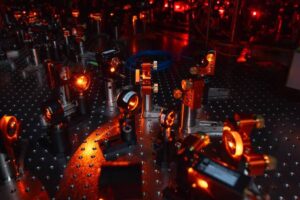
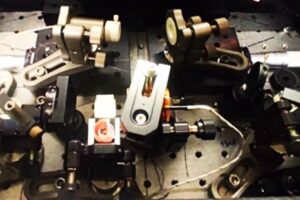
The optical parametric oscillator (OPO) used in the study

Researchers build light source with two entangled light beams

Substack subscription form sign up

Comments

  • Karoly Mirnics on Common Prescription Drugs May Disrupt Cholesterol Pathways in the Womb and Raise Autism Risk
  • Aizen on Laziness helped lead to extinction of Homo erectus
  • Norwood johnson on Electrons in New Crystals Behave as If They Live in Four Dimensions
  • ScienceBlog.com on Hidden Geometry Could Finally Fix Quantum Computers
  • Theo Prinse on America Is Going Back to the Moon. This Time, It Plans to Stay
© 2026 ScienceBlog.com | Follow our RSS / XML feed