Skip to content
ScienceBlog.com
  • Featured Blogs
    • EU Horizon Blog
    • ESA Tracker
    • Experimental Frontiers
    • Josh Mitteldorf’s Aging Matters
    • Dr. Lu Zhang’s Gondwanaland
    • NeuroEdge
    • NIAAA
    • SciChi
    • The Poetry of Science
    • Wild Science
  • Topics
    • Brain & Behavior
    • Earth, Energy & Environment
    • Health
    • Life & Non-humans
    • Physics & Mathematics
    • Social Sciences
    • Space
    • Technology
  • Our Substack
  • Follow Us!
    • Bluesky
    • Threads
    • FaceBook
    • Google News
    • Twitter/X
  • Contribute/Contact

Quantum Information

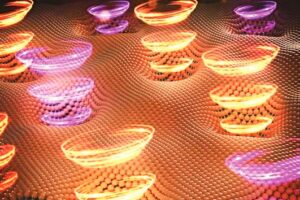
Formed within wells indented into the stack of two different layered materials, a monolayer semiconductor and an anti-ferromagnetic crystal, the chiral quantum light emissions rise up out of the material and could be used for quantum information and communication applications.

New quantum device generates single photons and encodes information

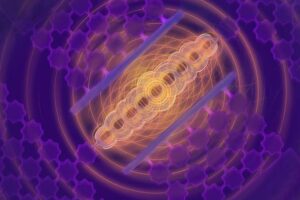
An artist's concept of a quantum memory storage device. It is rectangular and surrounded by a grid of smaller squares. Sound waves seem to radiate within it and out of it.

New Method Uses Sound Waves for Storing Quantum Information

Realization of a source-device-independent quantum random number generator secured by nonlocal dispersion cancellation. Credit: Ji-Ning Zhang

Quantum random number generator operates securely and independently of source devices

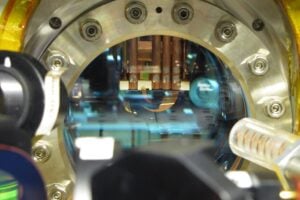
Vacuum chamber containing the atom chip

Paradoxical quantum phenomenon measured for the first time

Substack subscription form sign up

Comments

  • Josh Mitteldorf on Red States and Blue States Are Becoming the Same Unhappy Country
  • Josh Mitteldorf on Scientists Have Written the Rules for First Contact, and Step One Is Don’t Panic
  • John E on A New Theory Says DMT Entities Might Be Real, and Proposes How to Test It
  • ScienceBlog.com on A New Theory Says DMT Entities Might Be Real, and Proposes How to Test It
  • John E on A New Theory Says DMT Entities Might Be Real, and Proposes How to Test It
© 2026 ScienceBlog.com | Follow our RSS / XML feed