Skip to content
ScienceBlog.com
  • Featured Blogs
    • EU Horizon Blog
    • ESA Tracker
    • Experimental Frontiers
    • Josh Mitteldorf’s Aging Matters
    • Dr. Lu Zhang’s Gondwanaland
    • NeuroEdge
    • NIAAA
    • SciChi
    • The Poetry of Science
    • Wild Science
  • Topics
    • Brain & Behavior
    • Earth, Energy & Environment
    • Health
    • Life & Non-humans
    • Physics & Mathematics
    • Social Sciences
    • Space
    • Technology
  • Our Substack
  • Follow Us!
    • Bluesky
    • Threads
    • FaceBook
    • Google News
    • Twitter/X
  • Contribute/Contact

quantum mechanics

Illustration on photoexcitation of electrons in a potential well

Einstein’s Photons Hidden in the Fabric of Maxwell’s Fields

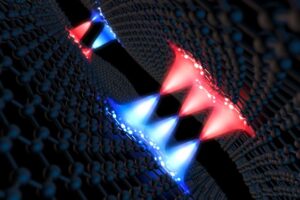
A new study finds that new quantum particles form by pairing quasiparticles that carry fractional charges. Courtesy of Demin Liu.

Scientists Discover New Quantum Particles That Break Classical Rules

A connection between quantum theory and information theory proved

A connection between quantum theory and information theory proved

An illustration of a quantum system that was simulated by both classical and quantum computers. The highlighted sections show how the influence of the system’s components is confined to nearby neighbors.

The surprising reason a classical computer beat a quantum computer at its own game

quantum coherence—the ability of particles to maintain phase relationships and exist in multiple states simultaneously

Quantum Coherence Survives in Ultracold Chemical Reaction

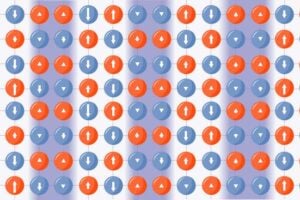
An illustration showing how electrons, which can have either an up or a down spin, can form a striped pattern in the Hubbard model. Recent breakthrough computations with this model are helping scientists better understand a class of high-temperature superconductors called cuprates.

Researchers Unveil Breakthrough in Understanding High-Temperature Superconductivity in Cuprates

An artistic rendering of ultra-high energy neutrinos passing through the Earth, with the IceCube Observatory sensors deep in the Antarctic glacier at the south pole.

Quantum Gravity Remains Elusive as Ultra-High Energy Neutrinos Show No Signs of Spacetime Fluctuations

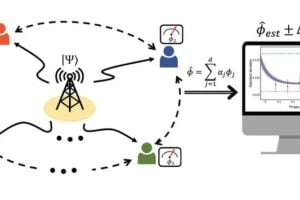
Send quantum states from a centralized location to each node distributed over a large area to obtain an average of the phases.

Quantum Sensor Boosts Precision Measurements

From left: Professor Sanfeng Wu, Professor Nai Phuan Ong and Dicke Fellow Tiancheng Song. Photo by Yanyu Jia

Researchers discover an abrupt change in quantum behavior that defies current theories of superconductivity

A trapped nanoparticle in vacuum at Wright Lab. (Credit: Tom Penny)

What goes up, must… be quantum? Experiment to test gravity’s quantum chops

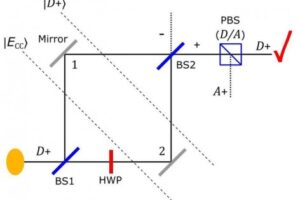
THE SIMPLE INTERFEROMETER USED IN THE QUANTUM CHESHIRE CAT SCENARIO, WHERE A PHOTON IS PREPARED IN THE PATH-POLARISATION ENTANGLED STATE ECC, BUT IS ONLY CONSIDERED IF IT ARRIVES ON OUTPUT PATH + WITH POLARISATION D. THE PARADOX ARISES WHEN WE CONSIDER THE PHOTON’S PATH, POLARISATION, AND PATH-POLARISATION CORRELATION, WHILE IT IS INSIDE THE INTERFEROMETER.

Quantum particles can’t separate from their properties, after all

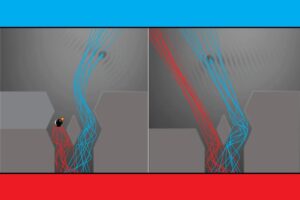
MIT mathematicians tracked a droplet as it bounced through a structure inspired by the theoretical “quantum bomb test.” The shows the droplet’s trajectories when the "bomb" is present, and the right panel shows the trajectories taken when the "bomb" is absent. Credits:Credit: Courtesy of the researchers

Classical Droplets Mimic Quantum Wonders: Bridging Worlds in Bomb-Detecting Behavior

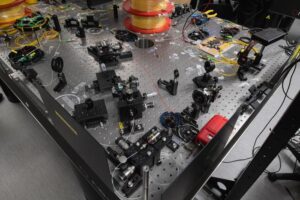
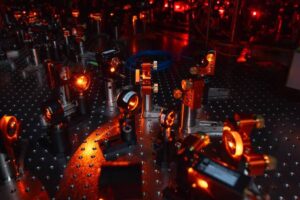
Laser setup for cooling, controlling, and entangling individual molecules. Photo by Richard Soden, Department of Physics

Physicists ‘entangle’ individual molecules for the first time

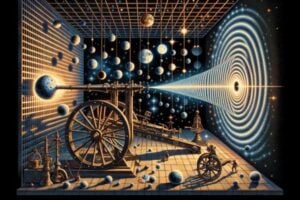
The image depicts an experiment in which heavy particles (illustrated as the moon), cause an interference pattern (a quantum effect), while also bending spacetime. The hanging pendulums depict the measurement of spacetime. The actual experiment is typically performed using Carbon-60, one of the largest known molecules. The UCL calculation indicates that the experiment should also be performed using higher density atoms such as gold. The other two images represent the two experiments proposed by the UCL group, both of which constrain any theory where spacetime is treated classically. One is the weighing of a mass, the other is an interference experiment.

New theory unites Einstein’s gravity with quantum mechanics

Older posts
Page1 Page2 Page3 Next →
Substack subscription form sign up

Comments

  • Kidreadytobreed on Global warming reduces available wind energy
  • James on Global warming reduces available wind energy
  • James on Global warming reduces available wind energy
  • Booklet AI on Key to online education: Test early and often
  • Karoly Mirnics on Common Prescription Drugs May Disrupt Cholesterol Pathways in the Womb and Raise Autism Risk
© 2026 ScienceBlog.com | Follow our RSS / XML feed