Skip to content
ScienceBlog.com
  • Featured Blogs
    • EU Horizon Blog
    • ESA Tracker
    • Experimental Frontiers
    • Josh Mitteldorf’s Aging Matters
    • Dr. Lu Zhang’s Gondwanaland
    • NeuroEdge
    • NIAAA
    • SciChi
    • The Poetry of Science
    • Wild Science
  • Topics
    • Brain & Behavior
    • Earth, Energy & Environment
    • Health
    • Life & Non-humans
    • Physics & Mathematics
    • Social Sciences
    • Space
    • Technology
  • Our Substack
  • Follow Us!
    • Bluesky
    • Threads
    • FaceBook
    • Google News
    • Twitter/X
  • Contribute/Contact

Quarks

Abstract colourful lines Credit: gremlin via Getty Images

Simulations Simplify Mystery of Elusive Quantum Particles

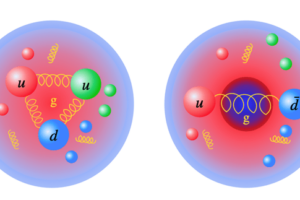
The two-dimensional spatial distribution of mass due to gluons in the nucleon (left) and the pion (right), simulated at seven valence pion masses with lattice quantum chromodynamics.

Mass Distribution Inside Subatomic Particles Mapped for First Time

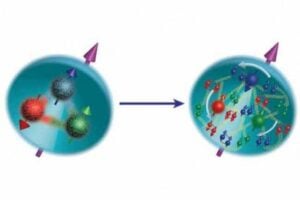
Understanding of the proton has changed from the 1980s view of the proton as made of three valence quarks (left) to the modern view that it is made of valence quarks, sea quarks, and gluons rotating in different directions around its spin axis (right).

New Theoretical Contribution Helps Examine the Internal Rotation of the Proton

Substack subscription form sign up

Comments

  • Norwood johnson on Electrons in New Crystals Behave as If They Live in Four Dimensions
  • ScienceBlog.com on Hidden Geometry Could Finally Fix Quantum Computers
  • Theo Prinse on America Is Going Back to the Moon. This Time, It Plans to Stay
  • george w on Hidden Geometry Could Finally Fix Quantum Computers
  • Tom Hughes on Years of Exercise, Blood Pressure Drugs Failed to Slow Cognitive Decline in Seniors at Dementia Risk
© 2026 ScienceBlog.com | Follow our RSS / XML feed