Skip to content
ScienceBlog.com
  • Featured Blogs
    • EU Horizon Blog
    • ESA Tracker
    • Experimental Frontiers
    • Josh Mitteldorf’s Aging Matters
    • Dr. Lu Zhang’s Gondwanaland
    • NeuroEdge
    • NIAAA
    • SciChi
    • The Poetry of Science
    • Wild Science
  • Topics
    • Brain & Behavior
    • Earth, Energy & Environment
    • Health
    • Life & Non-humans
    • Physics & Mathematics
    • Social Sciences
    • Space
    • Technology
  • Our Substack
  • Follow Us!
    • Bluesky
    • Threads
    • FaceBook
    • Google News
    • Twitter/X
  • Contribute/Contact

radio telescopes

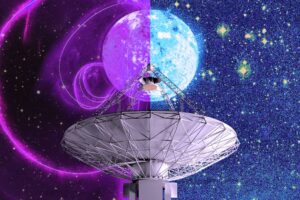
Artist’s depiction of CSIRO’s ASKAP radio telescope with two versions of the mysterious celestial object: neutron star or white dwarf

Astronomers Discover Slowest Spinning Neutron Star, Defying Expectations

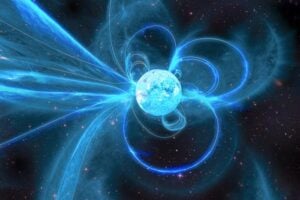
Artist’s impression of a magnetar.

Mysterious Radio Signals from Nearby Magnetar Baffle Scientists

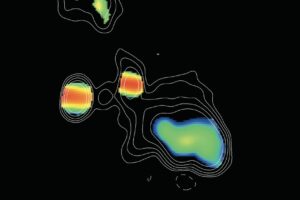
This image, taken by the Very Long Baseline Array (VLBA), shows two supermassive black holes, which appear as the blobs with red strips. The black holes are in the center of an elliptical galaxy. Colors represent different spectral slopes in radio emission, with red showing the most dense regions surrounding the black holes. The black hole on the right has likely recently devoured a massive star, which caused it to shoot out two ultrafast jets. The ends of those jets appear as green blobs above and below the black hole. This object, called J0405+3803, is referred to as a Compact Symmetric Object (CSO), because its jets are relatively close-in (or compact), compared to other black holes with much larger jets.

Sleeping supermassive black holes awakened briefly by shredded stars

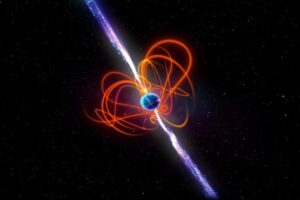
An artist’s impression of the ultra-long period magnetar. Astronomers discovered the object using the Murchison Widefield Array (MWA), a radio telescope on Wajarri Yamaji Country in outback Western Australia.

Astronomers find new type of stellar object

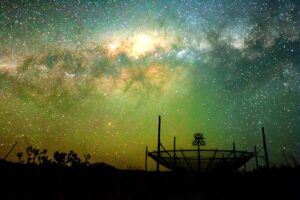
The HERA radio telescope, located in Karoo in South Africa, consists of 350 dishes pointed upward to detect radio waves from the early universe.

How different were galaxies in the early universe?

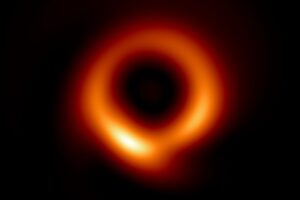
New image of M87 supermassive black hole generated by the PRIMO algorithm using 2017 EHT data

A sharper look at the M87 black hole

Astronomers capture radio signal from distant galaxy

Substack subscription form sign up

Comments

  • Karoly Mirnics on Common Prescription Drugs May Disrupt Cholesterol Pathways in the Womb and Raise Autism Risk
  • Aizen on Laziness helped lead to extinction of Homo erectus
  • Norwood johnson on Electrons in New Crystals Behave as If They Live in Four Dimensions
  • ScienceBlog.com on Hidden Geometry Could Finally Fix Quantum Computers
  • Theo Prinse on America Is Going Back to the Moon. This Time, It Plans to Stay
© 2026 ScienceBlog.com | Follow our RSS / XML feed