Skip to content
ScienceBlog.com
  • Featured Blogs
    • EU Horizon Blog
    • ESA Tracker
    • Experimental Frontiers
    • Josh Mitteldorf’s Aging Matters
    • Dr. Lu Zhang’s Gondwanaland
    • NeuroEdge
    • NIAAA
    • SciChi
    • The Poetry of Science
    • Wild Science
  • Topics
    • Brain & Behavior
    • Earth, Energy & Environment
    • Health
    • Life & Non-humans
    • Physics & Mathematics
    • Social Sciences
    • Space
    • Technology
  • Our Substack
  • Follow Us!
    • Bluesky
    • Threads
    • FaceBook
    • Google News
    • Twitter/X
  • Contribute/Contact

ray Observatories

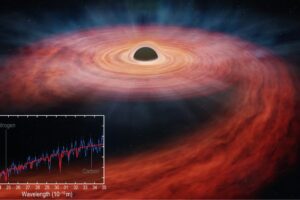
This artist’s illustration depicts the “tidal disruption event” (TDE) called ASASSN-14li, which is the focus of the latest study. As a star approached too closely to the supermassive black hole at the system, the strong gravity tore the star apart. This artist’s impression depicts the aftermath of this destruction. After the star was ripped apart, some of its gas (red) was left orbiting around and falling into the black hole. A portion of the gas was driven away in a wind (blue). Image credit: NASA/CXC/University of Michigan/J. Miller et al; Illustration: NASA/CXC/M.Weiss

A giant black hole destroys a massive star

Substack subscription form sign up

Comments

  • Mark Mellinger on Living Plastic Can Self-Destruct on Command
  • Marie Feret on The Silent Frequency That Makes Old Buildings Feel Haunted
  • Dax on The Silent Frequency That Makes Old Buildings Feel Haunted
  • Karoly Mirnics on Common Prescription Drugs May Disrupt Cholesterol Pathways in the Womb and Raise Autism Risk
  • Aizen on Laziness helped lead to extinction of Homo erectus
© 2026 ScienceBlog.com | Follow our RSS / XML feed