Skip to content
ScienceBlog.com
  • Featured Blogs
    • EU Horizon Blog
    • ESA Tracker
    • Experimental Frontiers
    • Josh Mitteldorf’s Aging Matters
    • Dr. Lu Zhang’s Gondwanaland
    • NeuroEdge
    • NIAAA
    • SciChi
    • The Poetry of Science
    • Wild Science
  • Topics
    • Brain & Behavior
    • Earth, Energy & Environment
    • Health
    • Life & Non-humans
    • Physics & Mathematics
    • Social Sciences
    • Space
    • Technology
  • Our Substack
  • Follow Us!
    • Bluesky
    • Threads
    • FaceBook
    • Google News
    • Twitter/X
  • Contribute/Contact

science

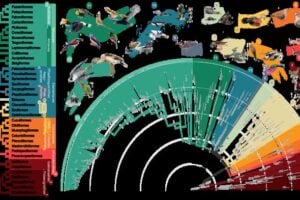
The updated bird family tree, published in Nature, delineating 93 million years of evolutionary relationships between 363 bird species.

Computational tools fuel reconstruction of new and improved bird family tree

Ohio State logo

A total eclipse, with a partial failure

Ohio State logo

Bedtime or go time? Observing what animals do during a total solar eclipse

Ohio State logo

What to expect when total solar eclipse passes through Ohio

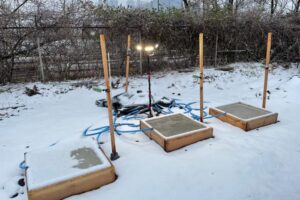
Self heating concrete samples

Self-heating concrete is one step closer to putting snow shovels and salt out of business

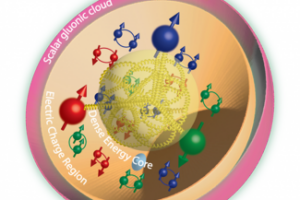
A proton’s valence quarks (blue, red, and green), quark-antiquark pairs, and gluons (springs). Scalar gluon activity (pink) extends beyond the electric charge radius (orange) that surrounds the gluonic energy core (yellow).

Scientists Locate the Missing Mass Inside the Proton

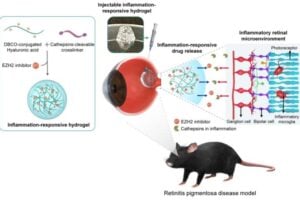
Schematic illustration of syringe-injectable inflammation-responsive hydrogel for suppression of inflammatory microglia for preventing photoreceptor death in retinitis pigmentosa.

New treatment developed to dramatically slow down the progression of blindness-causing retinal diseases

man sniffing a handkerchief

Sniffing women’s tears reduces aggressive behavior in men

Person scratching their arm

Uncovering a culprit behind the itch: Staphylococcus aureus

Gödel

What Gödel Wrought

Learning about objects: the treat is always only on the white plate or only on the black plate, the other is empty.

The way dogs see the world: Objects are more salient to smarter dogs

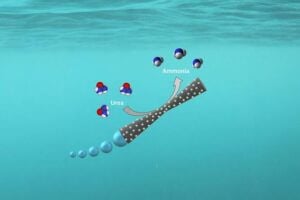
The outside of the micromotor in this study is coated with the chemical compound laccase. This enables the motor to convert the urea in the water into ammonia.

New water treatment method can generate green energy

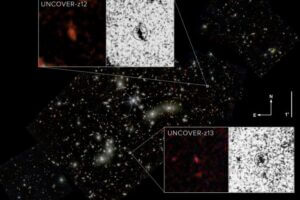
The second- and fourth-most distant galaxies ever seen (UNCOVER z-13 and UNCOVER z-12) have been confirmed using the James Webb Space Telescope’s Near-Infrared Camera (NIRCam). The galaxies are located in Pandora’s Cluster (Abell 2744), show here as near-infrared wavelengths of light that have been translated to visible-light colors. The scale of the main cluster image is labelled in arcseconds, which is a measure of angular distance in the sky. The circles on the black-and-white images, showing the galaxies in the NIRCam-F277W filter band onboard JWST, indicate an aperture size of 0.32 arcsec.

Second-most distant galaxy discovered using James Webb Space Telescope

iridescent butterfly image

The Butterfly’s Gaze

Older posts
Newer posts
← Previous Page1 Page2 Page3 Page4 Next →
Substack subscription form sign up

Comments

  • Josh Mitteldorf on Red States and Blue States Are Becoming the Same Unhappy Country
  • Josh Mitteldorf on Scientists Have Written the Rules for First Contact, and Step One Is Don’t Panic
  • John E on A New Theory Says DMT Entities Might Be Real, and Proposes How to Test It
  • ScienceBlog.com on A New Theory Says DMT Entities Might Be Real, and Proposes How to Test It
  • John E on A New Theory Says DMT Entities Might Be Real, and Proposes How to Test It
© 2026 ScienceBlog.com | Follow our RSS / XML feed