Skip to content
ScienceBlog.com
  • Featured Blogs
    • EU Horizon Blog
    • ESA Tracker
    • Experimental Frontiers
    • Josh Mitteldorf’s Aging Matters
    • Dr. Lu Zhang’s Gondwanaland
    • NeuroEdge
    • NIAAA
    • SciChi
    • The Poetry of Science
    • Wild Science
  • Topics
    • Brain & Behavior
    • Earth, Energy & Environment
    • Health
    • Life & Non-humans
    • Physics & Mathematics
    • Social Sciences
    • Space
    • Technology
  • Our Substack
  • Follow Us!
    • Bluesky
    • Threads
    • FaceBook
    • Google News
    • Twitter/X
  • Contribute/Contact

Semiconductor Technology

Subwavelength grated waveguide supporting polariton droplets (visualization: Antonio Gianfrate, source: CNR Nanotec).

Scientists Create Stable Quantum Droplets of Light for Advanced Simulations

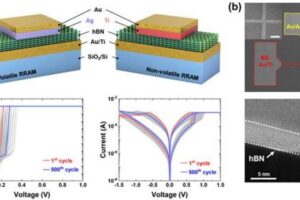
Two-dimensional material-based volatile and nonvolatile memory devices

Building Tomorrow’s AI with ‘Lego Blocks’

Structure of the proposed AI synaptic device. Two oxide semiconductor transistors are connected; one for writing and the other for reading.

AI “brain” created from core materials for OLED TVs

Peng Zhou uses a large lens to concentrate sunlight onto the water-splitting catalyst. Outdoors, the device was ten times more efficient than previous efforts at solar water splitting. Image credit: Brenda Ahearn/Michigan Engineering, Communications and Marketing

Cheap, sustainable hydrogen through solar power

Substack subscription form sign up

Comments

  • Marco Messina on More Than a Third of Americans Have Lost Relationships Over Politics
  • Anon on Why Fructose Behaves Less Like a Calorie and More Like a Hormone
  • Mark Mellinger on Living Plastic Can Self-Destruct on Command
  • Marie Feret on The Silent Frequency That Makes Old Buildings Feel Haunted
  • Dax on The Silent Frequency That Makes Old Buildings Feel Haunted
© 2026 ScienceBlog.com | Follow our RSS / XML feed