Skip to content
ScienceBlog.com
  • Featured Blogs
    • EU Horizon Blog
    • ESA Tracker
    • Experimental Frontiers
    • Josh Mitteldorf’s Aging Matters
    • Dr. Lu Zhang’s Gondwanaland
    • NeuroEdge
    • NIAAA
    • SciChi
    • The Poetry of Science
    • Wild Science
  • Topics
    • Brain & Behavior
    • Earth, Energy & Environment
    • Health
    • Life & Non-humans
    • Physics & Mathematics
    • Social Sciences
    • Space
    • Technology
  • Our Substack
  • Follow Us!
    • Bluesky
    • Threads
    • FaceBook
    • Google News
    • Twitter/X
  • Contribute/Contact

social media

tweets

95% of sponsored influencer posts on X/Twitter were not disclosed

illustration of woman awake in bed

One hour’s screen use after going to bed increases your risk of insomnia by 59%, scientists find

Man looking bored

AI Writing Tools Quietly Neutralize Human Emotions

woman on a dating app

Why dating apps are fueling cosmetic procedures

woman texting

Digital Danger: Screen Time in Preteens Linked to Manic Behavior Two Years Later

giel on social media late a t night

The Loneliness Paradox: Social Media’s Active Users Just as Isolated as Passive Scrollers

bots abstract

Social Media Bots Create More Chatter But Less Meaningful Conversation, Research Shows

man screaming

How Digital Outrage Helps Misinformation Go Viral

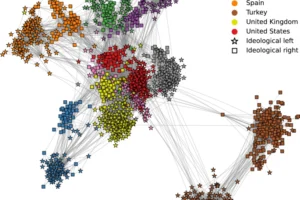
The figure depicts a co-retweet network where nodes correspond to individual politicians and an edge is drawn between two nodes if those politicians share common retweeters (see “Methods”). Square nodes correspond to politicians classified as members of the ideological right, star nodes correspond to politicians classified as members of the ideological left, as determined using the latent ideology (see Fig. 2). The network visualization is produced using a force directed drawing algorithm (see “Methods”), in which repulsive forces are applied between pairs of nodes to push nodes apart, and attractive forces are applied to any pair of nodes which are connected by an edge. Nodes are colored according to the country of each elected politician. Canada: Pink, France: Green, Germany: Gray, Italy: Purple, Poland: Blue, Spain: Orange, Turkey: Brown, United Kingdom: Yellow, United States: Red.

Cross-Country Study Reveals Similar Patterns of Political Toxicity on Social Media

Government regimes may be learning new Twitter tactics to quash dissent

Study Shows X/Twitter Algorithm Influences News Quality Over Quantity

Fake news illustration

Study: Combined Approach More Effective at Fighting Election Misinformation

Echo chamber formation sharpened by priority

Study Shows Verified Social Media Users Can Drive Opinion Polarization

hooded figure at laptop

Small Group of Users Dominate Anti-Immigration Content on UK Twitter, Study Finds

Communication professor JungHwan Yang is a member of a research team that explored the biases associated with political polls posted on social media, how their results compare with those reported by mainstream media and their potential influence on public discourse.

Will social media polls accurately predict the winner of the U.S. presidential election?

Older posts
Page1 Page2 … Page4 Next →
Substack subscription form sign up

Comments

  • Karoly Mirnics on Common Prescription Drugs May Disrupt Cholesterol Pathways in the Womb and Raise Autism Risk
  • Aizen on Laziness helped lead to extinction of Homo erectus
  • Norwood johnson on Electrons in New Crystals Behave as If They Live in Four Dimensions
  • ScienceBlog.com on Hidden Geometry Could Finally Fix Quantum Computers
  • Theo Prinse on America Is Going Back to the Moon. This Time, It Plans to Stay
© 2026 ScienceBlog.com | Follow our RSS / XML feed