Skip to content
ScienceBlog.com
  • Featured Blogs
    • EU Horizon Blog
    • ESA Tracker
    • Experimental Frontiers
    • Josh Mitteldorf’s Aging Matters
    • Dr. Lu Zhang’s Gondwanaland
    • NeuroEdge
    • NIAAA
    • SciChi
    • The Poetry of Science
    • Wild Science
  • Topics
    • Brain & Behavior
    • Earth, Energy & Environment
    • Health
    • Life & Non-humans
    • Physics & Mathematics
    • Social Sciences
    • Space
    • Technology
  • Our Substack
  • Follow Us!
    • Bluesky
    • Threads
    • FaceBook
    • Google News
    • Twitter/X
  • Contribute/Contact

Soft Robotics

Illustration of spinal cord

Flexible, Robotic Nerve ‘Cuffs’ Offer Potential for Minimally Invasive Monitoring and Treatment of Neurological Conditions


Rendering of pleurocystitid (left) next to the soft robot they modeled after the ancient sea creature.

How ancient sea creatures can inform soft robotics

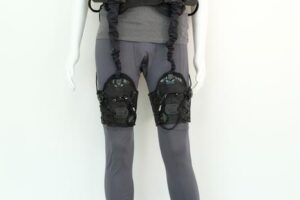
The robotic garment (above), worn around the hips and thighs, gives a gentle push to the hips as the leg swings, helping the patient achieve a longer stride.

Soft robotic, wearable device improves walking for individual with Parkinson’s disease

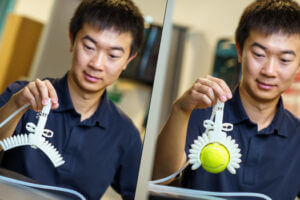
Example of new UC San Diego device that can grip objects with no electronics involved.

This 3D Printed Gripper Doesn’t Need Electronics To Function

Actuation of ferroelectric polymers driven by Joule heating. Credit: Qing Wang. All Rights Reserved.

New ferroelectric material could give robots muscles

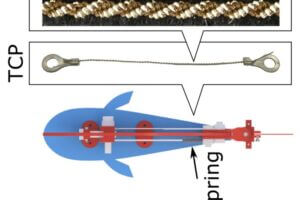
Illustration of robot fish and its Antagonistic muscles

Robot fish makes splash with motion breakthrough

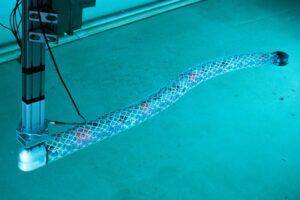
Researchers have come up with an innovative approach to building deformable underwater robots using simple repeating substructures. The team has demonstrated the new system in two different example configurations, one like an eel, pictured here in the MIT tow tank. Credits:Credit: Courtesy of the researchers

Engineers devise a system to produce efficient aquabots

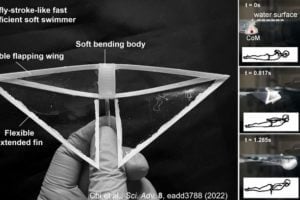
Inspired by the biomechanics of the manta ray, researchers at North Carolina State University have developed an energy-efficient soft robot that can swim more than four times faster than previous swimming soft robots. The robots are called “butterfly bots,” because their swimming motion resembles the way a person’s arms move when they are swimming the butterfly stroke.

‘Butterfly bot’ is fastest swimming soft robot yet

Substack subscription form sign up

Comments

  • Norwood johnson on Electrons in New Crystals Behave as If They Live in Four Dimensions
  • ScienceBlog.com on Hidden Geometry Could Finally Fix Quantum Computers
  • Theo Prinse on America Is Going Back to the Moon. This Time, It Plans to Stay
  • george w on Hidden Geometry Could Finally Fix Quantum Computers
  • Tom Hughes on Years of Exercise, Blood Pressure Drugs Failed to Slow Cognitive Decline in Seniors at Dementia Risk
© 2026 ScienceBlog.com | Follow our RSS / XML feed