Skip to content
ScienceBlog.com
  • Featured Blogs
    • EU Horizon Blog
    • ESA Tracker
    • Experimental Frontiers
    • Josh Mitteldorf’s Aging Matters
    • Dr. Lu Zhang’s Gondwanaland
    • NeuroEdge
    • NIAAA
    • SciChi
    • The Poetry of Science
    • Wild Science
  • Topics
    • Brain & Behavior
    • Earth, Energy & Environment
    • Health
    • Life & Non-humans
    • Physics & Mathematics
    • Social Sciences
    • Space
    • Technology
  • Our Substack
  • Follow Us!
    • Bluesky
    • Threads
    • FaceBook
    • Google News
    • Twitter/X
  • Contribute/Contact

solar energy

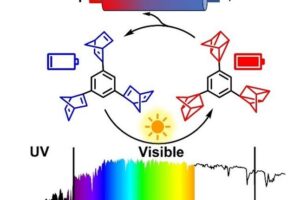
Storing energy in chemical bonds using a large fraction of the solar spectrum

New approach paves the way for harvesting and storing solar energy efficiently

Mock-up of solar evaporation system (left), connected to temperature and humidity detection system (center), with a brine water injection system (right) and a purified water collection system.

Solar-Powered Water Purification: A Breakthrough in Desalination

Illinois researchers have opened up the AI "black box" to gain valuable new insight about chemistry for solar energy applications. Pictured, from left: Professor Charles Schroeder, graduate students Changhyun Hwang and Seungjoo Yi, professor Ying Diao, professor Nick Jackson and graduate student Tiara Torres Flores. Photo by Michelle Hassel

AI Unveils Chemical Secrets for Solar Energy: Turning the Black Box Transparent

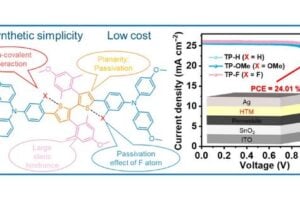
The schematic illustrates the structural benefits of three bithiophene-based hole transport materials (TP-H, TP-OMe, and TP-F) designed for perovskite solar cells (PSCs). These materials feature large steric hindrance, non-covalent interactions, and passivation effects, which simplify synthesis and reduce costs. The performance comparison graph reveals that the TP-F-based PSC achieves a power conversion efficiency (PCE) of 24.01%, surpassing TP-H and TP-OMe. The device configuration diagram shows the layer structure, including the hole transport material (HTM), which contributes to the high efficiency.

Solar Cells Breakthrough: New Materials Boost Efficiency and Cut Costs

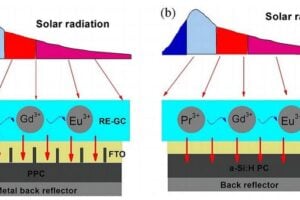
Applying a transparent Pr3+/Eu3+-doped glass-ceramic layer on top of a photovoltaic cell simultaneously protects it from damaging UV light and converts that UV radiation to visible light, thereby enhancing the light-to-energy conversion efficiency.

Boosting solar cell performance with a transparent spectral converter

Solar panels on a green lawn. credit pixabay

Hong Kong Researchers Achieve Record Efficiency of 19.31% in Organic Solar Cells

Solar panels on an industrial rooftop

Solar roofs could power 1/3 of US manufacturing

Emergence of the bitriplet exciton in crystalline pentacene.

Exciton fission: One photon in, two electrons out

Illustration of demo in orbit

Caltech to Launch Space Solar Power Tech Demo into Orbit

EU awards €5 million prize to research team for harnessing the sun to make fuel from water

Substack subscription form sign up

Comments

  • Karoly Mirnics on Common Prescription Drugs May Disrupt Cholesterol Pathways in the Womb and Raise Autism Risk
  • Aizen on Laziness helped lead to extinction of Homo erectus
  • Norwood johnson on Electrons in New Crystals Behave as If They Live in Four Dimensions
  • ScienceBlog.com on Hidden Geometry Could Finally Fix Quantum Computers
  • Theo Prinse on America Is Going Back to the Moon. This Time, It Plans to Stay
© 2026 ScienceBlog.com | Follow our RSS / XML feed