Skip to content
ScienceBlog.com
  • Featured Blogs
    • EU Horizon Blog
    • ESA Tracker
    • Experimental Frontiers
    • Josh Mitteldorf’s Aging Matters
    • Dr. Lu Zhang’s Gondwanaland
    • NeuroEdge
    • NIAAA
    • SciChi
    • The Poetry of Science
    • Wild Science
  • Topics
    • Brain & Behavior
    • Earth, Energy & Environment
    • Health
    • Life & Non-humans
    • Physics & Mathematics
    • Social Sciences
    • Space
    • Technology
  • Our Substack
  • Follow Us!
    • Bluesky
    • Threads
    • FaceBook
    • Google News
    • Twitter/X
  • Contribute/Contact

solar observation missions

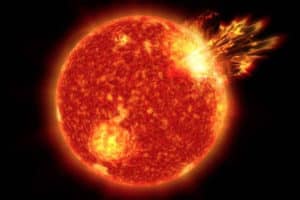
In the simulations, a tight ring of polar vortices forms at around 55 degrees latitude, the equivalent of Earth’s Arctic circle. After forming, the vortices head toward the poles in a tightening ring, shedding vortices as the circle closes, eventually leaving only a pair of vortices directly abutting the poles before they disappear altogether at solar maximum. How many vortices form and their configuration as they move toward the poles changes with the strength of the solar cycle.

Computer Models Reveal Solar Polar Vortices for First Time

Substack subscription form sign up

Comments

  • Ashok Kumar on Machine Learning Matched the Right Lifestyle Fix to Each Depressed Patient, Doubling Remission Rates
  • Curtis Webber on The GPS-Killer? This Quantum Device ‘Feels’ Motion Like a Brain—Down to the Atomic Level
  • Ran on How the Age You First Had Sex Could Shape How You Age Decades Later
  • Sparty on How the Age You First Had Sex Could Shape How You Age Decades Later
  • Josh Mitteldorf on A Single TV Segment Sent Leucovorin Prescriptions for Autistic Children Soaring 2,000 Percent
© 2026 ScienceBlog.com | Follow our RSS / XML feed