Skip to content
ScienceBlog.com
  • Featured Blogs
    • EU Horizon Blog
    • ESA Tracker
    • Experimental Frontiers
    • Josh Mitteldorf’s Aging Matters
    • Dr. Lu Zhang’s Gondwanaland
    • NeuroEdge
    • NIAAA
    • SciChi
    • The Poetry of Science
    • Wild Science
  • Topics
    • Brain & Behavior
    • Earth, Energy & Environment
    • Health
    • Life & Non-humans
    • Physics & Mathematics
    • Social Sciences
    • Space
    • Technology
  • Our Substack
  • Follow Us!
    • Bluesky
    • Threads
    • FaceBook
    • Google News
    • Twitter/X
  • Contribute/Contact

space communication

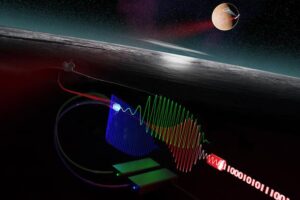
In the new communication system from researchers at Chalmers University of Technology, in Sweden, a weak optical signal (red) from the spacecraft's transmitter can be amplified noise-free when it encounters two so-called pump waves (blue and green) of different frequencies in a receiver on Earth. Thanks to the researchers' noise-free amplifiers in the receiver, the signal is kept undisturbed and the reception on Earth becomes record-sensitive, which in turn paves the way for a more error-free and faster data transmission in space in the future.

Faster space communication with record-sensitive receiver

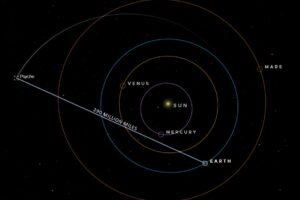
This visualization shows Psyche’s position on July 29 when the uplink station for NASA’s Deep Space Optical Communications sent a laser signal about 290 million miles to the spacecraft. See an interactive version of the Psyche spacecraft in NASA’s Eyes on the Solar System. Credit: NASA/JPL-Caltech

NASA’s Laser Communication Breaks Distance Record, Paving Way for Future Space Exploration

Substack subscription form sign up

Comments

  • Karoly Mirnics on Common Prescription Drugs May Disrupt Cholesterol Pathways in the Womb and Raise Autism Risk
  • Aizen on Laziness helped lead to extinction of Homo erectus
  • Norwood johnson on Electrons in New Crystals Behave as If They Live in Four Dimensions
  • ScienceBlog.com on Hidden Geometry Could Finally Fix Quantum Computers
  • Theo Prinse on America Is Going Back to the Moon. This Time, It Plans to Stay
© 2026 ScienceBlog.com | Follow our RSS / XML feed