Skip to content
ScienceBlog.com
  • Featured Blogs
    • EU Horizon Blog
    • ESA Tracker
    • Experimental Frontiers
    • Josh Mitteldorf’s Aging Matters
    • Dr. Lu Zhang’s Gondwanaland
    • NeuroEdge
    • NIAAA
    • SciChi
    • The Poetry of Science
    • Wild Science
  • Topics
    • Brain & Behavior
    • Earth, Energy & Environment
    • Health
    • Life & Non-humans
    • Physics & Mathematics
    • Social Sciences
    • Space
    • Technology
  • Our Substack
  • Follow Us!
    • Bluesky
    • Threads
    • FaceBook
    • Google News
    • Twitter/X
  • Contribute/Contact

Space science

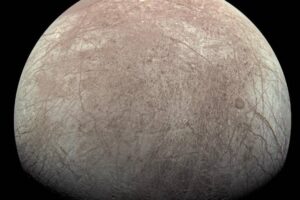
This view of Jupiter’s icy moon Europa was captured by the JunoCam imager aboard NASA’s Juno spacecraft during the mission’s close flyby on Sept. 29, 2022. Credit: Image data: NASA/JPL-Caltech/SwRI/MSSS Image processing: Kevin M. Gill CC BY 3.0 Full Image Details

NASA’s Juno Mission Measures Oxygen Production at Europa

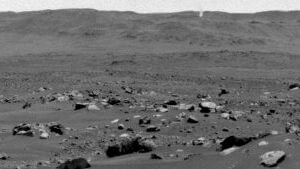
Martian dustdevil

NASA’s Perseverance Captures Dust-Filled Martian Whirlwind

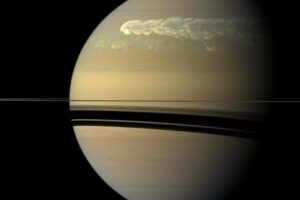
Saturn

The Storms of Saturn

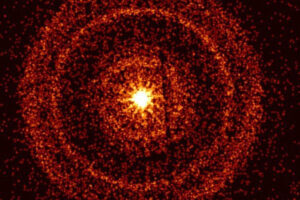
The afterglow of the Brightest of All Time gamma-ray burst, captured by the Neil Gehrels Swift Observatory’s X-Ray Telescope. Credit: NASA/Swift/A. Beardmore (University of Leicester)

Unprecedented Cosmic Blast Stuns Scientists with Unusual Brilliance and Enigmatic Afterglow

The panet Saturn with its trademark rings

Saturn’s rings are really young and mostly water

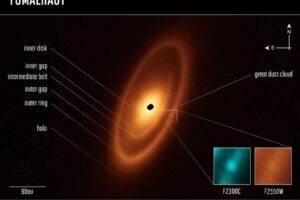
This image of the dusty debris disk surrounding the young star Fomalhaut is from Webb’s Mid-Infrared Instrument (MIRI). It reveals three nested belts extending out to 14 billion miles (23 billion kilometers) from the star. The inner belts – which had never been seen before – were revealed by Webb for the first time. Labels at left indicate the individual features. At right, a great dust cloud is highlighted and pullouts show it in two infrared wavelengths: 23 and 25.5 microns. Credits: NASA, ESA, CSA, A. Gáspár (University of Arizona). Image processing: A. Pagan (STScI)

Local Star Fomalhaut’s Dust Belts Nicer than Ours, May Have Invisible Flatmates

galaxy clusters

Galaxy clusters yield new evidence for standard model of cosmology

sun

Shedding light on the Sun

meteor streaking across day sky

Two meteorites are providing a detailed look into outer space

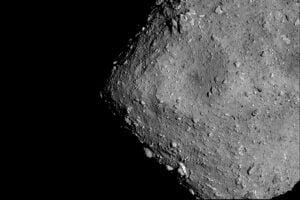
Ryugu asteroid closeup

Ryugu asteroid shares secrets on how the solar system was formed

Samples of asteroid Ryugu analysed at IPGP

Ryugu: Asteroid samples continue to shed light on solar system history

Substack subscription form sign up

Comments

  • Kidreadytobreed on Global warming reduces available wind energy
  • James on Global warming reduces available wind energy
  • James on Global warming reduces available wind energy
  • Booklet AI on Key to online education: Test early and often
  • Karoly Mirnics on Common Prescription Drugs May Disrupt Cholesterol Pathways in the Womb and Raise Autism Risk
© 2026 ScienceBlog.com | Follow our RSS / XML feed