Skip to content
ScienceBlog.com
  • Featured Blogs
    • EU Horizon Blog
    • ESA Tracker
    • Experimental Frontiers
    • Josh Mitteldorf’s Aging Matters
    • Dr. Lu Zhang’s Gondwanaland
    • NeuroEdge
    • NIAAA
    • SciChi
    • The Poetry of Science
    • Wild Science
  • Topics
    • Brain & Behavior
    • Earth, Energy & Environment
    • Health
    • Life & Non-humans
    • Physics & Mathematics
    • Social Sciences
    • Space
    • Technology
  • Our Substack
  • Follow Us!
    • Bluesky
    • Threads
    • FaceBook
    • Google News
    • Twitter/X
  • Contribute/Contact

Space telescope

NASA’s SPHEREx mission will survey the Milky Way galaxy looking for water ice and other key ingredients for life. In the search for these frozen compounds, the mission will focus on molecular clouds — collections of gas and dust in space — like this one imaged by the agency’s James Webb Space Telescope. Credit: NASA, ESA, CSA

NASA’s New Space Telescope to Hunt for Ice That Could Harbor Life’s Origins

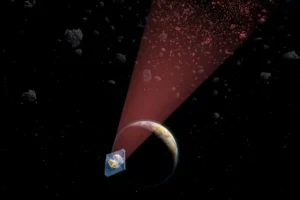
An artist’s illustration of NASA’s James Webb Space Telescope revealing a population of small asteroids in the main asteroid belt.

Team Unveils Hidden Population of Bus-Sized Asteroids Lurking in Solar System’s Main Belt

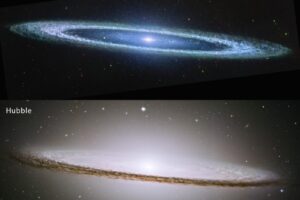
This image compares the view of the famous Sombrero Galaxy in mid-infrared light (top) and visible light (bottom). NASA’s James Webb Space Telescope’s MIRI (Mid-Infrared Instrument) reveals the smooth inner disk of the galaxy.

Webb’s New View Transforms Iconic Sombrero Galaxy into Cosmic Archery Target

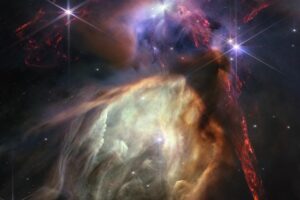
The first anniversary image from NASA’s James Webb Space Telescope displays star birth like it’s never been seen before, full of detailed, impressionistic texture. The subject is the Rho Ophiuchi cloud complex, the closest star-forming region to Earth. It is a relatively small, quiet stellar nursery, but you’d never know it from Webb’s chaotic close-up. Jets bursting from young stars crisscross the image, impacting the surrounding interstellar gas and lighting up molecular hydrogen, shown in red. Some stars display the telltale shadow of a circumstellar disk, the makings of future planetary systems. Download the full-resolution, uncompressed version and supporting visuals from the Space Telescope Science Institute: https://webbtelescope.org/contents/media/images/2023/128/01H449193V5Q4Q6GFBKXAZ3S03?news=true

Webb celebrates first year of science with close-up on birth of sun-like stars

Substack subscription form sign up

Comments

  • Sue Ann Hayes on Hidden Nuclear Protein Fuels Pancreatic Cancer’s Deadly Aggression
  • Curtis Webber on The GPS-Killer? This Quantum Device ‘Feels’ Motion Like a Brain—Down to the Atomic Level
  • Ran on How the Age You First Had Sex Could Shape How You Age Decades Later
  • Sparty on How the Age You First Had Sex Could Shape How You Age Decades Later
  • Josh Mitteldorf on A Single TV Segment Sent Leucovorin Prescriptions for Autistic Children Soaring 2,000 Percent
© 2026 ScienceBlog.com | Follow our RSS / XML feed