Skip to content
Menu
Featured Blogs
EU Horizon Blog
ESA Tracker
Experimental Frontiers
Josh Mitteldorf’s Aging Matters
Dr. Lu Zhang’s Gondwanaland
NeuroEdge
SciChi
The Poetry of Science
Wild Science
Topics
Brain & Behavior
Earth, Energy & Environment
Health
Life & Non-humans
Physics & Mathematics
Social Sciences
Space
Technology
Our Substack
Follow Us!
Bluesky
Threads
FaceBook
Google News
Twitter/X
Contribute/Contact
space telescopes
Hubble and Webb Reveal Mysteriously Smooth Disk Around Bright Star Vega
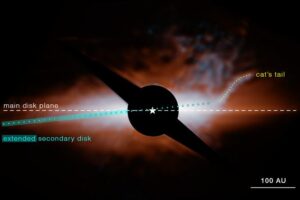
NASA’s Webb discovers dusty ‘cat’s tail’ in Beta Pictoris System
Cosmic Harmonies: Sonifications From NASA Telescopes
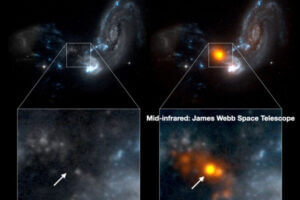
‘Engine’ of luminous merging galaxies pinpointed for the first time
Webb spies an exoplanet atmosphere as never seen before

![Hubble and Webb Observations of Vega Circumstellar Debris Disk. [left]-A Hubble Space Telescope false-color view of a 100-billion-mile-wide disk of dust around the summer star Vega. Hubble detects reflected light from dust that is the size of smoke particles largely in a halo on the periphery of the disk. The disk is very smooth, with no evidence of embedded large planets. The black spot at the center blocks out the bright glow of the hot young star. [right]-The James Webb Space Telescope resolves the glow of warm dust in a disk halo, at 23 billion miles out. The outer disk (analogous to the solar system’s Kuiper Belt) extends from 7 billion miles to 15 billion miles. The inner disk extends from the inner edge of the outer disk down to close proximity to the star. There is a notable dip in surface brightness of the inner disk from approximately 3.7 to 7.2 billion miles. The black spot at the center is due to lack of data from saturation.](https://scienceblog.com/wp-content/uploads/2024/11/vega-disk-300x200.jpeg)