Skip to content
ScienceBlog.com
  • Featured Blogs
    • EU Horizon Blog
    • ESA Tracker
    • Experimental Frontiers
    • Josh Mitteldorf’s Aging Matters
    • Dr. Lu Zhang’s Gondwanaland
    • NeuroEdge
    • NIAAA
    • SciChi
    • The Poetry of Science
    • Wild Science
  • Topics
    • Brain & Behavior
    • Earth, Energy & Environment
    • Health
    • Life & Non-humans
    • Physics & Mathematics
    • Social Sciences
    • Space
    • Technology
  • Our Substack
  • Follow Us!
    • Bluesky
    • Threads
    • FaceBook
    • Google News
    • Twitter/X
  • Contribute/Contact

star formation

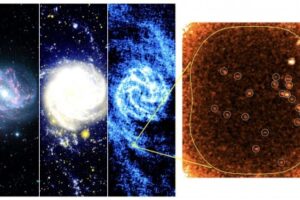
Research on the far edge of galaxy M83 reveals unusual star formation in an extreme environment. This area, outlined in yellow, is shown in data from several different instruments. From left to right: optical image from CTIO, ultraviolet image from GALEX, HI 21cm image from VLA and GBT, and CO(3-2) image from ALMA. In this last image, the star-forming “hearts” of molecular clouds, circled with white, are shown.

Mystery of Star Formation Revealed by Hearts of Molecular Clouds

University of Michigan astronomer Sally Oey studied a star-forming region in host galaxy, NGC 2366, which is a typical dwarf irregular galaxy. Image courtesy: Observatorio de Calar Alto, J. van Eymeren (AIRUB, ATNF) & Á.R. López-Sánchez

Dwarf galaxies use 10-million-year quiet period to churn out stars

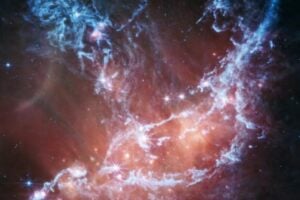
This new infrared image of NGC 346 from NASA’s James Webb Space Telescope’s Mid-Infrared Instrument (MIRI) traces emission from cool gas and dust. In this image blue represents silicates and sooty chemical molecules known as polycyclic aromatic hydrocarbons, or PAHs. More diffuse red emission shines from warm dust heated by the brightest and most massive stars in the heart of the region. Bright patches and filaments mark areas with abundant numbers of protostars. This image includes 7.7-micron light shown in blue, 10 microns in cyan, 11.3 microns in green, 15 microns in yellow, and 21 microns in red (770W, 1000W, 1130W, 1500W, and 2100W filters, respectively).

NASA’s Webb captures an ethereal view of NGC 346

Artist conception of early starbursting galaxies. The image is rendered from FIRE simulation data used for this research that can explain recent JWST results. Stars and galaxies are shown in the bright white points of light, while the more diffuse dark matter and gas are shown in purples and reds.

Bursts of star formation explain mysterious brightness at cosmic dawn

Artistic composition of a “soup” of prebiotic molecules around a protoplanetary disc.

Molecules precursors to life discovered in the Perseus Cloud

Newer posts
← Previous Page1 Page2
Substack subscription form sign up

Comments

  • John E on A New Theory Says DMT Entities Might Be Real, and Proposes How to Test It
  • Simon on A New Theory Says DMT Entities Might Be Real, and Proposes How to Test It
  • Sue Ann Hayes on Hidden Nuclear Protein Fuels Pancreatic Cancer’s Deadly Aggression
  • Curtis Webber on The GPS-Killer? This Quantum Device ‘Feels’ Motion Like a Brain—Down to the Atomic Level
  • Ran on How the Age You First Had Sex Could Shape How You Age Decades Later
© 2026 ScienceBlog.com | Follow our RSS / XML feed