Skip to content
ScienceBlog.com
  • Featured Blogs
    • EU Horizon Blog
    • ESA Tracker
    • Experimental Frontiers
    • Josh Mitteldorf’s Aging Matters
    • Dr. Lu Zhang’s Gondwanaland
    • NeuroEdge
    • NIAAA
    • SciChi
    • The Poetry of Science
    • Wild Science
  • Topics
    • Brain & Behavior
    • Earth, Energy & Environment
    • Health
    • Life & Non-humans
    • Physics & Mathematics
    • Social Sciences
    • Space
    • Technology
  • Our Substack
  • Follow Us!
    • Bluesky
    • Threads
    • FaceBook
    • Google News
    • Twitter/X
  • Contribute/Contact

stellar activity

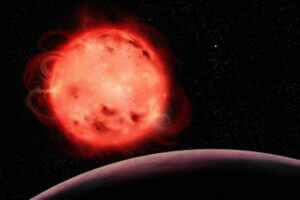
This artistic representation of the TRAPPIST-1 red dwarf star showcases its very active nature. The star appears to have many stellar spots (colder regions of its surface, similar to sunspots) and flares. The exoplanet TRAPPIST-1 b, the closest planet to the system’s central star, can be seen in the foreground with no apparent atmosphere. The exoplanet TRAPPIST-1 g, one of the planets in the system’s habitable zone, can be seen in the background to the right of the star. The TRAPPIST-1 system contains seven Earth-sized exoplanets.

New insights into the atmosphere and star of an exoplanet

Substack subscription form sign up

Comments

  • Aizen on Laziness helped lead to extinction of Homo erectus
  • Norwood johnson on Electrons in New Crystals Behave as If They Live in Four Dimensions
  • ScienceBlog.com on Hidden Geometry Could Finally Fix Quantum Computers
  • Theo Prinse on America Is Going Back to the Moon. This Time, It Plans to Stay
  • george w on Hidden Geometry Could Finally Fix Quantum Computers
© 2026 ScienceBlog.com | Follow our RSS / XML feed